
From a Village Chor Bazaar to AI-Era Precision Optics — A Journalist’s Journey Back to Glasses, and the Friend Who Changed Everything
By Vijay Gaikwad Journalist | Policy Analyst | Advocate
One — The Dusty Road and the First Frame
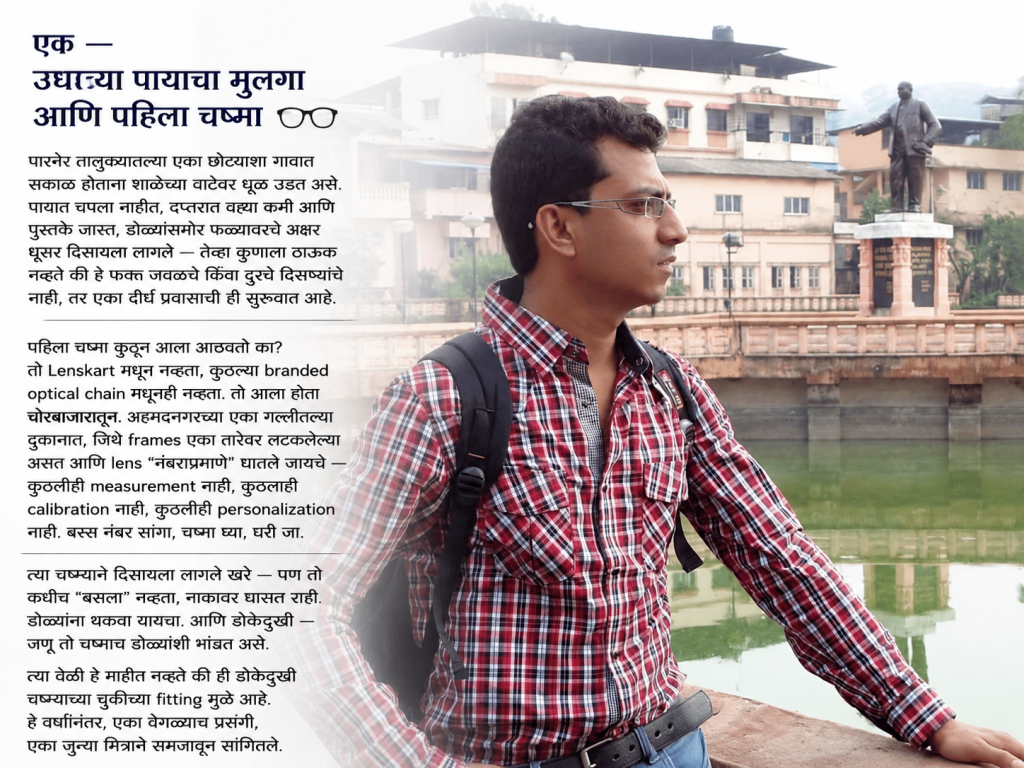
The mornings in a small village in Parner taluka, Ahmednagar district, had a particular quality to them. Dust rising from unpaved roads. The smell of groundnut fields at harvest. The sound of schoolchildren walking, some barefoot, some in slippers one size too large, all carrying the weight of ambition in their cloth bags.
I was one of those children.
I don’t remember exactly when my vision first blurred. It happens gradually, the way things that matter most tend to — not in a dramatic moment but through a slow accumulation of squinting, of moving closer to the blackboard, of choosing a front bench not out of eagerness but necessity. By the time anyone noticed, the numbers had already settled into my eyes like unwelcome tenants.
The first spectacle frame I owned did not come from a brand. It came from a chor bazaar — one of those lanes in Ahmednagar where frames hung on wire hooks and lenses were fitted by feel, not measurement. “Tell me your number,” the man said. He fitted the lens. I paid. I left.
That frame never truly fit. It slid down my nose in the heat. It pressed behind my ears by evening. And there was always — always — a low, persistent headache that I accepted as normal. As the price of seeing.
It took thirty years, and one extraordinary friend, for me to understand that it was never normal at all.
Two — Studio Lights, Akashvani, and the Glare Nobody Warned About
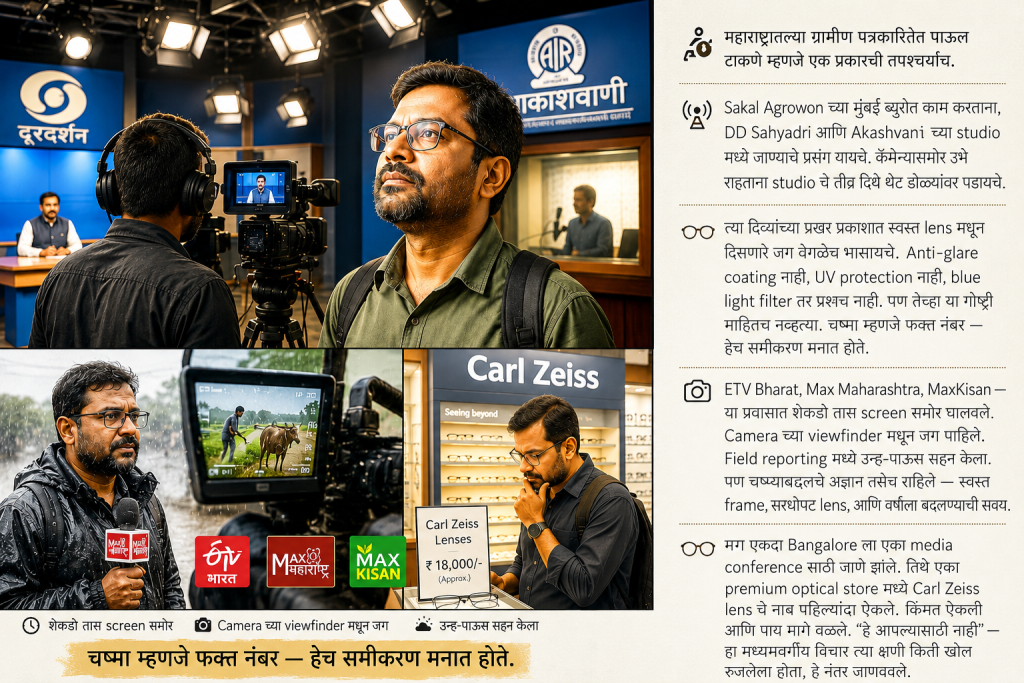
A rural journalist in Maharashtra does not arrive. He accumulates — experience, contacts, stories, kilometres. My twelve years at Sakal Agrowon’s Mumbai bureau were followed by stints at ETV Bharat, Max Maharashtra, MaxKisan. Along the way came the studios — DD Sahyadri, Akashvani — where the lights were harsh and bright and indiscriminate.
Standing before a camera in those years, wearing cheap lenses with no anti-reflective coating, I would feel the studio lights bounce off the glass and into my peripheral vision like silent interference. No one told me about anti-glare technology. No one mentioned UV protection or blue light filtration. Glasses were a medical necessity, not a precision instrument. You got a number, you got a frame, you got on with your life.
I remember a media conference in Bangalore once, where I walked past a premium optical store and saw a display for Carl Zeiss lenses. I looked at the price. I walked on. The thought that passed through my mind was simple and devastating in its quiet acceptance: This is not for people like me.
That thought — rooted in class, in geography, in a rural upbringing where premium always meant elsewhere — stayed with me longer than it should have. It took a friendship to dislodge it.
Three — LASIK, and Eleven Years of Extraordinary Freedom
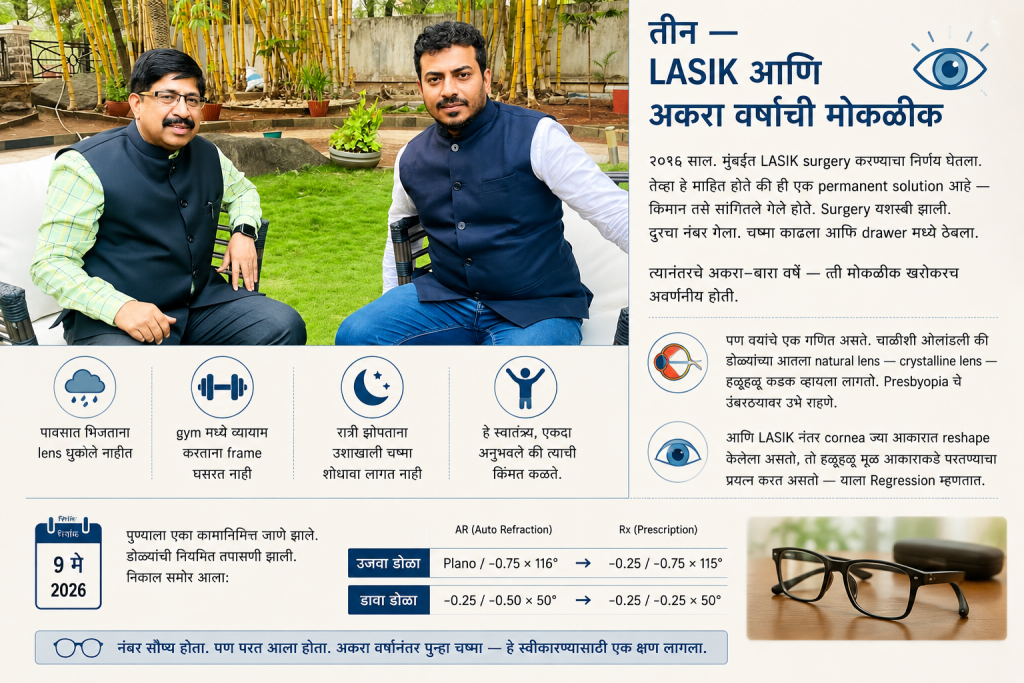
In 2016, I underwent LASIK surgery in Mumbai. The procedure corrected my distance vision completely. I packed my glasses into a drawer and forgot about them.
What followed were eleven years I can only describe as a particular kind of liberation. Rain on your face without fogged lenses. Exercise without frames slipping mid-stride. Falling asleep without the ritual of finding a safe place for something fragile. Simple things, but cumulatively profound. The kind of freedom you only fully understand once you have experienced its absence.
Post-LASIK life also came with a silent clock, though I didn’t know it then.
After forty, the human eye’s crystalline lens — the natural lens inside the eye — begins to harden. Accommodation reduces. What optometrists call presbyopia begins to establish itself at the margins of daily life. And the cornea that was reshaped during LASIK, held in its new curvature by surgical precision, can begin the slow process of shifting back toward its original form. This is regression. It is natural. It is documented. And it is rarely discussed clearly enough with LASIK patients.
On May 9, 2026, I visited Pune for work. A routine eye examination revealed the following:
Right Eye (AR): Plano / -0.75 × 116° Right Eye (Rx): -0.25 / -0.75 × 115°
Left Eye (AR): -0.25 / -0.50 × 50° Left Eye (Rx): -0.25 / -0.25 × 50°
Mild. Undeniably mild. But there it was — distance power, returning after eleven years of absence.
I needed glasses again. The question was: what kind?
Four — Tushar Phule: A Batchmate, an Expert, a Reckoning
Some friendships announce themselves loudly. Others simply accumulate presence over years until you realise, without being able to identify the precise moment, that this person has become essential.
Tushar Phule is the second kind.
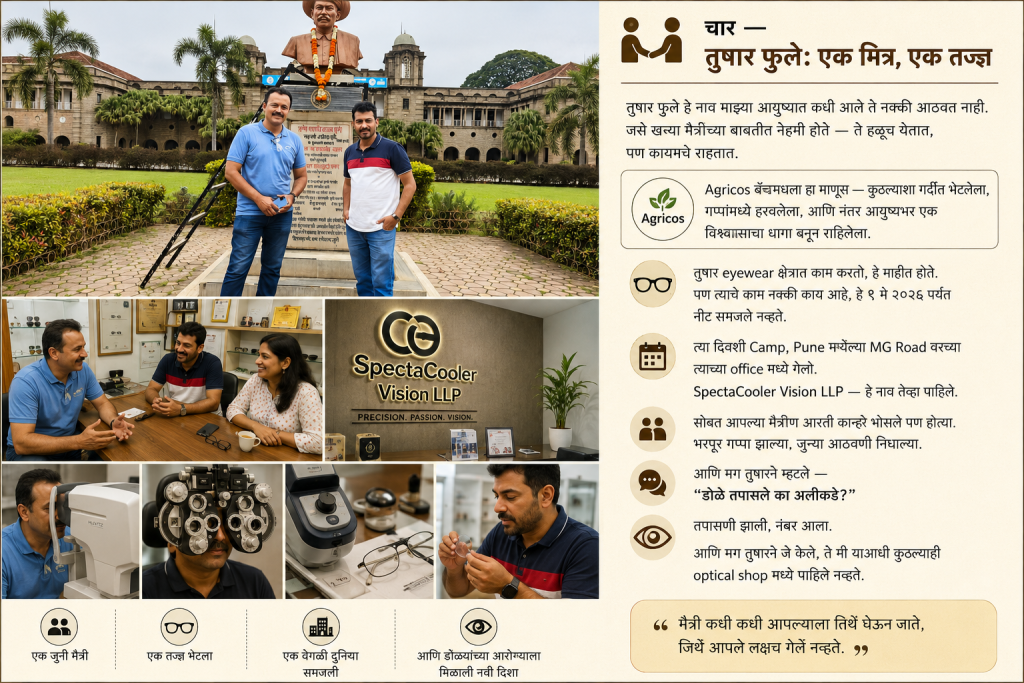
We shared an Agricos batch — one of those collegiate connections that survive not because of proximity but because of genuine resonance. Over the years I knew, in the general way one knows things about old friends, that he worked in eyewear. That he had built something in Pune. That his name came up in conversations about optical quality with a consistency that registered, if not fully.
On May 9, 2026, I walked into his office at SpectaCooler Vision LLP on MG Road, Camp, Pune. Our mutual friend Aarti Kanhare Bhosale was there too. We talked for a long time — about the years behind us, about work, about the particular texture of friendships that survive distance and decade.
Then Tushar asked, with the mild directness that characterises people who are very good at what they do: “When did you last have your eyes checked?”
I told him. He listened. And then he did something I had never seen done in any optical shop in thirty years of wearing glasses.
Five — The Scientific Portrait of a Face
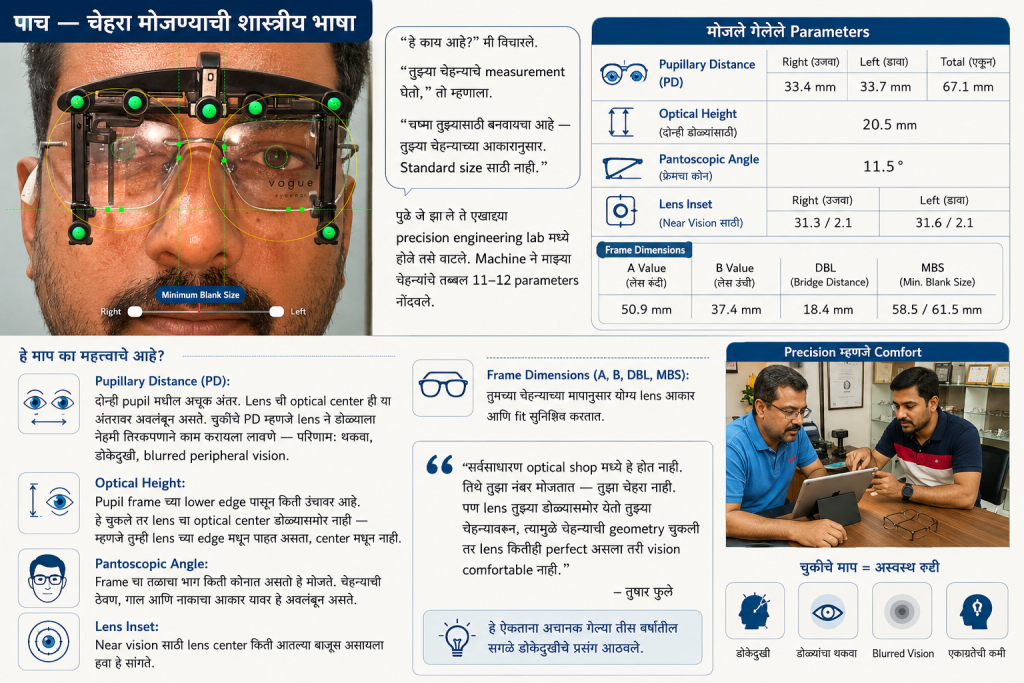
Tushar brought out a machine. An iPad connected to a precision facial measurement system. Software calibrated, sensors ready.
“What is this for?” I asked.
“Measuring your face,” he said. “Not your number. Your face.”
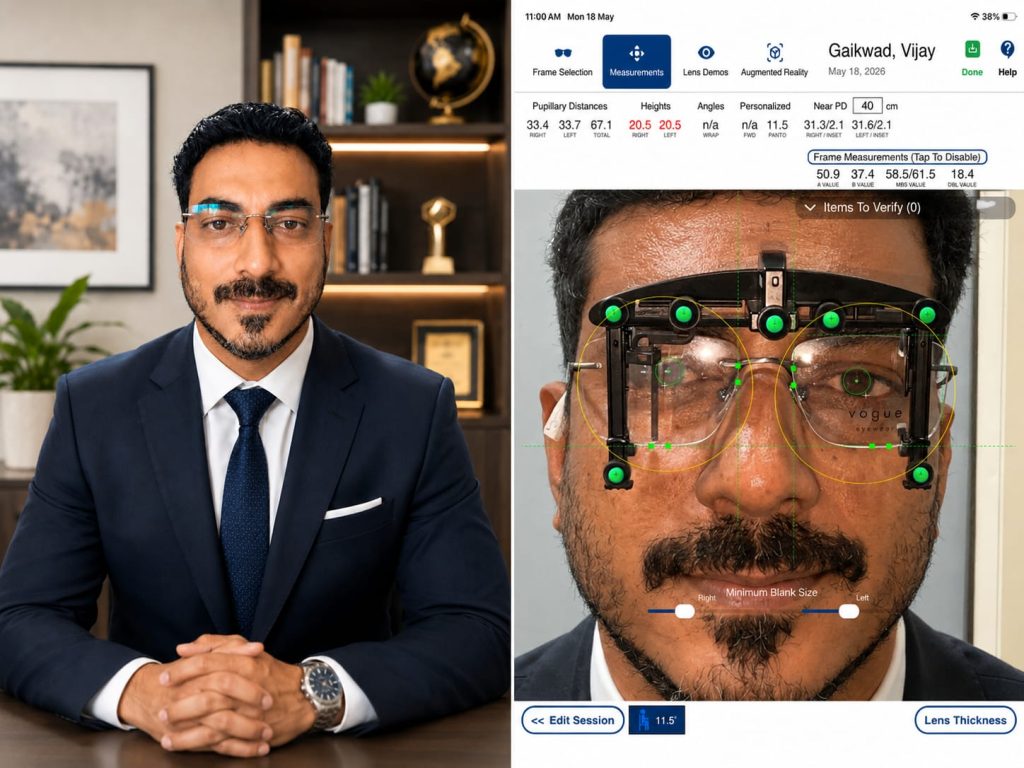
Over the next several minutes, the system recorded eleven to twelve distinct facial parameters. Each one, Tushar explained, plays a direct role in how well a pair of glasses actually works — not just optically, but ergonomically, neurologically, in terms of sustained comfort over hours of wear.
Pupillary Distance (PD): Right 33.4mm | Left 33.7mm | Total 67.1mm. This is the distance between the centres of both pupils. The optical centre of each lens must align precisely with this measurement. An incorrect PD means your eyes are perpetually working at a slight diagonal — compensating, straining, fatiguing by mid-afternoon in ways that feel like concentration failures but are actually mechanical.
Optical Height: 20.5mm for both eyes. The vertical distance from the pupil to the lower edge of the frame. If this is off, the optical centre of the lens does not sit in front of the eye — you end up looking through the edge of the lens, not the centre.
Pantoscopic Angle: 11.5°. The tilt of the frame’s lower rim relative to the vertical. Every face has a different geometry — the prominence of cheekbones, the bridge of the nose, the depth of the orbital socket — and the frame must account for all of it.
Lens Inset (Near PD): Right 31.3/2.1 | Left 31.6/2.1. For near vision zones, the lens centre shifts inward. The precise amount depends on your unique facial geometry.
Frame Dimensions: A Value (lens width) 50.9mm | B Value (lens height) 37.4mm | Bridge Distance 18.4mm | Minimum Blank Size 58.5/61.5mm.
“Why does all of this matter?” I asked.
Tushar looked at me the way expert people look when they have explained something many times and learned to do so without impatience. “Standard optical shops measure your prescription. They do not measure your face. But the lens reaches your eye via your face — via your nose bridge, your orbital depth, the distance from your pupil to the frame. If the geometry is wrong, it doesn’t matter how perfect the prescription is. The vision will be uncomfortable.”
I sat quietly for a moment.
Every headache. Every tired evening. Every afternoon where I thought my concentration was failing. Some of it — perhaps much of it — was the glasses.
Six — Carl Zeiss and the Gift That Arrived Before I Understood It
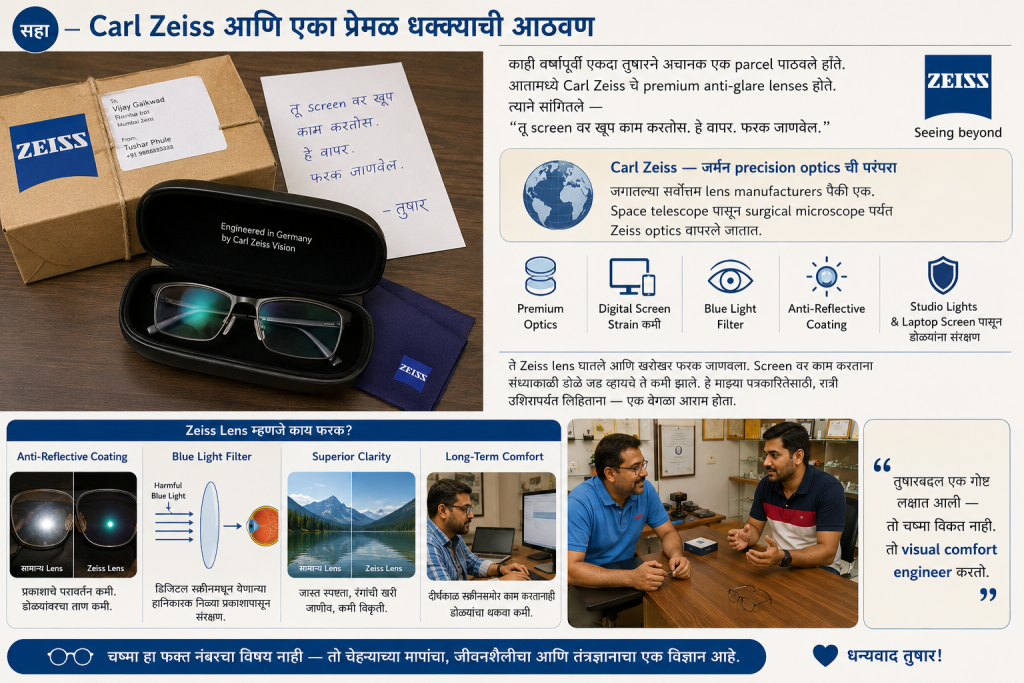
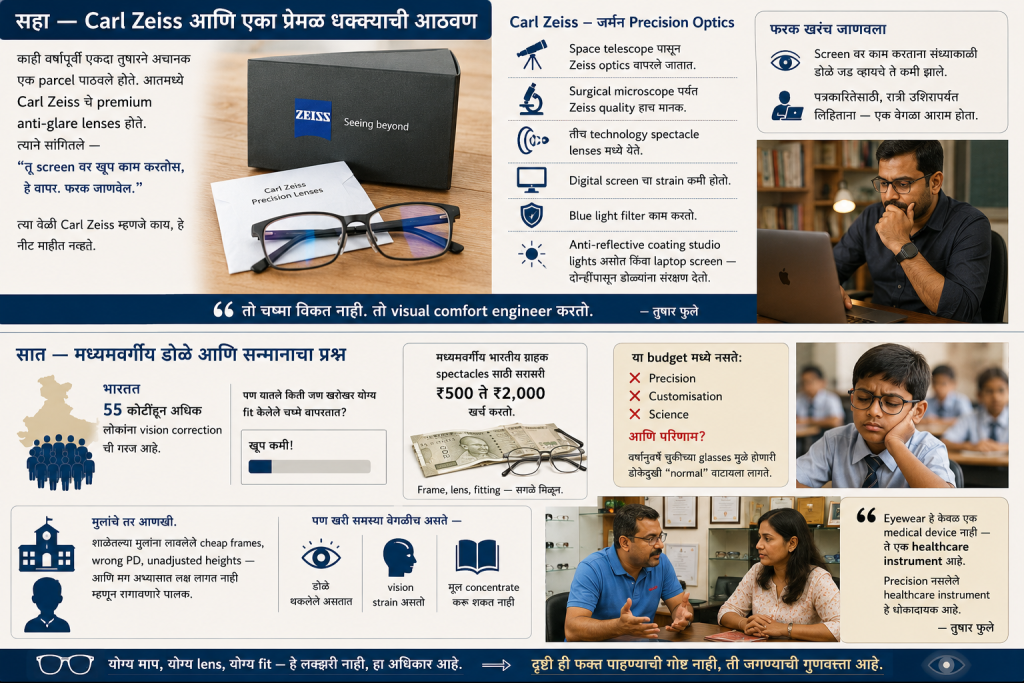
Several years before this conversation, Tushar had sent me a parcel without announcement. Inside were Carl Zeiss premium anti-glare lenses. He’d had them fitted into a frame and sent them with a simple note: You work too much on screen. Use these.
At the time, I knew Zeiss as a name — the way one knows names that carry authority without fully understanding the source. What I did not know was that Carl Zeiss AG, founded in Jena, Germany in 1846, produces optical systems of a precision that extends from space telescopes to surgical microscopes to, yes, spectacle lenses. That their Digital Free-Form technology represented one of the genuine revolutions in modern optics. That anti-reflective coating on a Zeiss lens is not cosmetic — it is functional, reducing the kind of reflected light that in harsh studio conditions or on bright laptop screens creates a cumulative visual fatigue that most people misattribute to age or stress.
I wore those lenses. By evening, I noticed a difference. Not dramatic — precision rarely is dramatic. But the persistent low-level strain that I had normalised was simply less. The screen did not feel like an adversary at 11pm. My eyes, when I finally stopped working, did not feel like they had been through a long argument.
That was when I began to understand, imprecisely but genuinely, that Tushar did not sell spectacles. He engineered visual comfort.
Seven — The Middle-Class Eye and the Question of Dignity
India has over 550 million people who need vision correction. Of these, a substantial majority wear glasses that were never properly fitted to their face. The frames are standard sizes. The lenses are conventionally ground. The PD is estimated, not measured. The optical height is approximate.
The consequences accumulate quietly: persistent headaches attributed to stress, eye strain blamed on screens, afternoon fatigue ascribed to age. All of it accepted as the normal cost of seeing — when in fact it is the specific, preventable cost of imprecision.
Children are particularly affected. A child in school wearing incorrectly fitted glasses — wrong PD, approximate optical height, frame geometry that doesn’t account for a smaller face — will struggle to concentrate. Not because of any learning difficulty, but because their visual system is working against itself. The parents, seeing a child who won’t focus, intervene in the wrong direction. The glasses are rarely examined.
Tushar has spoken about this extensively. For him, eyewear is not merely a medical device. It is a healthcare instrument. And an imprecise healthcare instrument is not simply ineffective — it causes harm.
The question he is effectively asking, through the work he does at SpectaCooler Vision LLP, is a question about dignity: Why should precision optics be a privilege reserved for those who can afford to know it exists?
Eight — Digital Free-Form Lens Technology: The Revolution Nobody Explained
Digital Free-Form Lens Technology sounds, at first encounter, like marketing language. It is not.
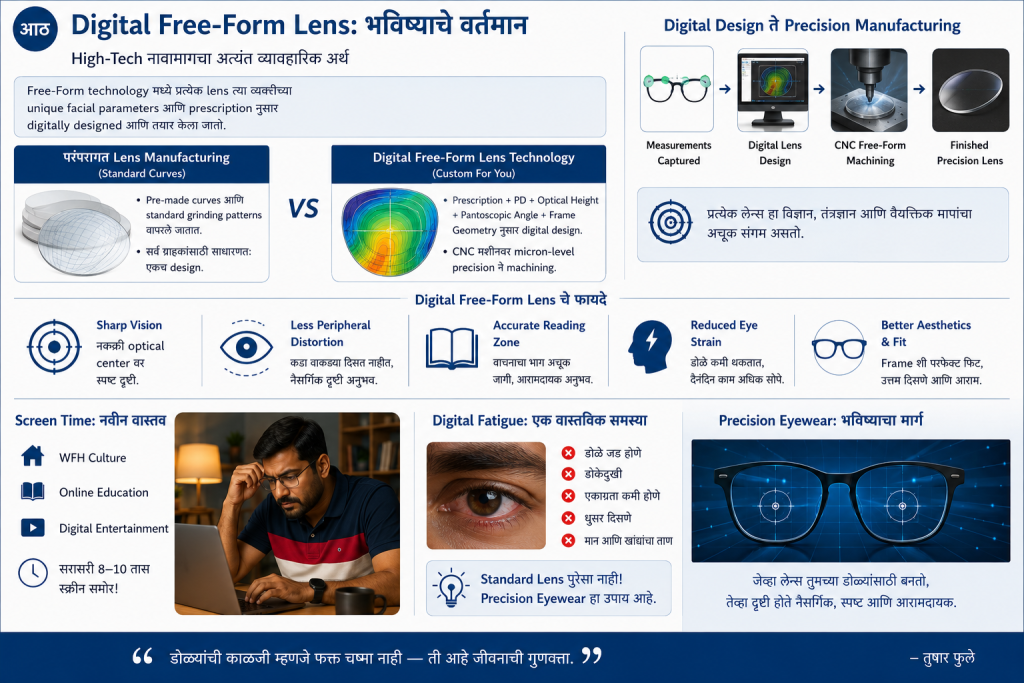
Conventional lens manufacturing works with pre-determined curves — standardised grinding patterns applied to lens blanks. The result is a lens that is optically correct at its centre but introduces distortion toward the periphery, particularly as prescriptions become more complex.
Free-Form technology reverses this logic. Every surface of the lens is machined individually, using CNC equipment capable of micron-level precision, based on a digital file that incorporates the specific prescription, the specific PD, the specific optical height, the specific pantoscopic angle, and the specific frame geometry of the individual wearer. The result is a lens where optical performance is optimised across the entire surface — not just the centre.
The practical difference: sharper peripheral vision. More accurate reading zones in progressive lenses. Reduced distortion during eye movement. And significantly less ciliary muscle fatigue — because the eye does not have to constantly compensate for lens imperfection.
In a post-COVID world where average screen exposure has climbed to eight to ten hours per day for knowledge workers, this is not a luxury specification. Digital fatigue is physiologically real. Its causes are multiple — blue light, refresh rate, focal distance — but one significant and often overlooked contributor is the quality and precision of the lenses you are looking through. A well-fitted, correctly specified Free-Form lens does not eliminate screen fatigue. But it reduces its severity measurably.
Nine — SpectaCooler Vision LLP: An Entrepreneur’s Vision
Tushar Phule’s professional journey is not a single straight line. From his earlier work with Optimilan Frameworks Pvt Ltd to the current SpectaCooler Vision LLP, his evolution reflects the particular intelligence of entrepreneurs who understand their domain deeply enough to know when a model needs to change — not merely a name, but a philosophy.
The optical ecosystem of Camp, Pune — MG Road and its surrounds — has its own history. It is one of those commercial districts where old establishments and new enterprise coexist, where trust is built across generations and word-of-mouth still carries more weight than advertising.
Into this ecosystem, Tushar brought a specific proposition: premium precision technology should not be confined to metropolitan elites. Carl Zeiss lenses, Digital Free-Form customisation, machine-based facial mapping — these should be accessible to the engineer in Pune, the journalist from Ahmednagar, the schoolteacher in Nashik.
This is easier to state than to execute. It requires technology investment. It requires rigorous training. It requires the patient, persistent work of educating customers who do not yet know what they do not know about their own vision. And it requires maintaining pricing that does not exclude the very people it is meant to serve.
The trust economy that underlies Indian entrepreneurship at its best — the economy of recommendation, of shared history, of a friend who sends you Zeiss lenses in a parcel because he thinks you need them before you know you do — is precisely what Tushar has built. Not just a business. A reputation.
Ten — India’s Eyewear Economy and the Precision Revolution
India’s eyewear market was valued at USD 10.4 billion in 2024. Conservative projections place it at USD 19.6 billion by 2033. The fastest-growing segment within that expansion is precision customised eyewear, recording a CAGR of over 31 percent.
These are not simply market statistics. They reflect a social transition — the gradual, uneven but genuine movement of Indian consumers toward demanding quality in healthcare products they had previously accepted as standardised utilities.
The global precision optics market in healthcare is being reshaped by several converging forces: the proliferation of 3D scanning and facial mapping technology, the democratisation of CNC manufacturing, the rise of AI-assisted prescription analysis, and the growing clinical awareness of digital eye strain as a public health concern.
In this context, enterprises like SpectaCooler Vision LLP occupy an important position — not just as commercial ventures but as nodes in an emerging ecosystem of precision healthcare at accessible price points. The question they are answering, through daily practice, is: Can the best available optical technology reach the person who needs it most?
In Maharashtra, in 2026, the answer is beginning to be yes.
Eleven — The Measurement, the Frame, the Moment
On the morning of May 18, 2026, at 11am, the iPad screen in SpectaCooler Vision LLP’s office displayed a simple header:
Gaikwad, Vijay. May 18, 2026.
Below it, the measurements. Every number a coordinate in the geometry of my face. Every coordinate feeding into the specification of a lens that would be machined, not merely ground — built, not simply assembled.
The frame was selected not by style alone but by fit — by how its geometry corresponded to the facial measurements the machine had recorded. Carl Zeiss Digital Free-Form lenses, anti-glare, blue light filtration, UV protection.
When I put the glasses on, the first thing I noticed was the absence of what I had always assumed was inevitable: the pressure at the nose bridge, the mild strain behind the eyes, the sense that the glasses were sitting on my face rather than belonging to it.
They felt, with a quietness that was itself a kind of eloquence, simply right.
“This is what it should feel like,” Tushar said.
Thirty years. Thirty years of accepting something lesser as normal.
Twelve — Friendship, Trust, and the Philosophy of Clear Vision
There is a category of people in any life who improve not just your circumstances but your understanding. They don’t do it through counsel or instruction. They do it by demonstrating — through their expertise, their care, their commitment to excellence in the specific domain they have mastered — that things can be better than you assumed.
Tushar Phule is, for me, one of those people.
The journey from a village chor bazaar frame to Carl Zeiss Digital Free-Form lenses is not simply a consumer story. It is a story about what happens when precision meets trust — when someone who knows deeply, genuinely cares about the outcome.
India has 550 million people who need to see more clearly. Many of them are wearing the modern equivalent of what I wore as a child in Parner — frames chosen by availability, lenses fitted by approximation, comfort accepted as secondary. The headaches are normalised. The fatigue is attributed to age. The possibility of better is simply not known.
That knowledge gap is where Tushar works. Not loudly. Not with the language of disruption that technology entrepreneurship has borrowed from Silicon Valley. But steadily, precisely — the way good optical work is done.
Epilogue
A good spectacle frame improves vision.
But the right person — the one who measures not just your number but your face, who thinks about your comfort not just your prescription, who sends you Zeiss lenses in a parcel before you know you need them — that person improves perspective.
For anyone in Maharashtra, in India, who has never found glasses that truly fit — who has normalised discomfort, accepted headaches, and quietly concluded that premium precision is for someone else — I want to say clearly:
It is for you. It has always been for you. You simply hadn’t met the right person yet.
Contact
SpectaCooler Vision LLP 327, MG Road, above YES Bank, Camp, Pune — 411001 📞 +91 81234 53555 🌐 Google Maps