
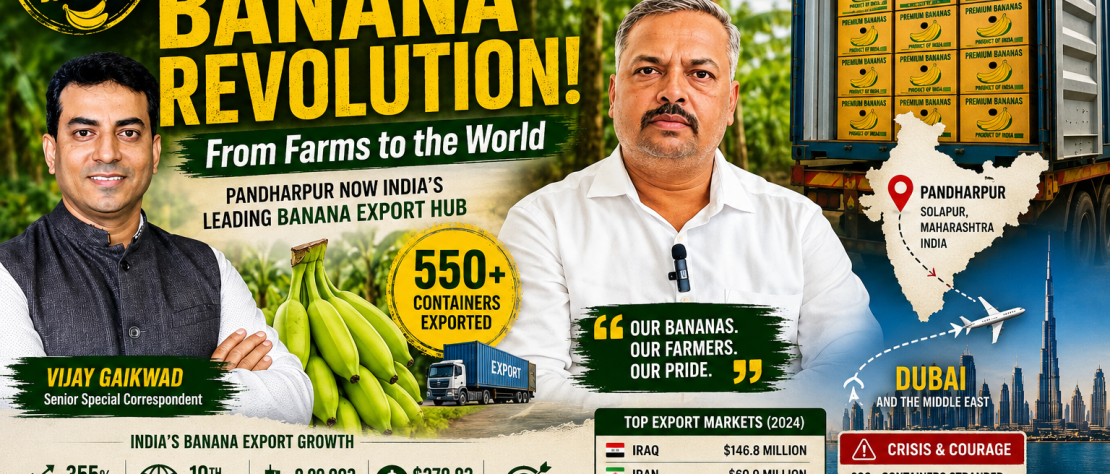
— How Pramod Nirmal Built a Banana Empire from Pandharpur’s Sacred Soil
📸 Photo: Pramod Nirmal — Banana Exporter, Pandharpur, Solapur District, Maharashtra
🎥 Watch Full Video Report: Click Here — YouTube
✍️ Vijay Gaikwad | Senior Agricultural Journalist & Policy Analyst 📍 Pandharpur, Solapur District, Maharashtra | 📅 May 21, 2026
🙏 A City That Breathes Faith
There is a road in Maharashtra that leads to God.
It runs through sugarcane fields and sun-baked plains, past bullock carts and diesel pumps, through villages where the walls carry faded portraits of Tukaram and Dnyaneshwar. Every June and November, millions of feet walk this road — barefoot, blistered, and filled with a devotion so ancient it feels geological.
They are going to Pandharpur.
They are going to see Vitthal — the dark-skinned god who stands with hands on hips at the banks of the Chandrabhaga River, waiting, as he has waited for centuries, for his people to arrive.
Pandharpur is not merely a town. It is a heartbeat. It is the emotional capital of Maharashtra’s soul — where the poor, the farmer, the broken, and the faithful all arrive as equals before the divine.
But in the shadow of that ancient temple, in the dust and heat of Solapur’s relentless summer, something entirely new has been growing.
Not a temple. Not a shrine.
A banana economy.
🌱 The Soil That Held a Secret
Drive forty minutes from the Vitthal temple and the landscape shifts. The spiritual gives way to the agricultural. Rows upon rows of banana trees — their broad, green leaves catching the morning light like outstretched palms — stretch across the earth as far as the eye can see.
This belt of Maharashtra — Solapur, Sangli, Jalgaon — has always grown bananas. The soil knows them. The farmers know them. Generation after generation, a man would plant his banana saplings, watch them grow, harvest the bunch, load it onto a tempo, and drive it to the local market — where a middleman would set the price, and the farmer would accept it, because what other choice did he have?
The math was brutal and simple. Grow more, earn less. Work harder, stay poorer.
There was no storage infrastructure. No cold chain. No grading system. No direct access to buyers. The farmer stood at the bottom of a food chain he had no power to navigate.
The harvest was his. The profit was not.
This is the world that Pramod Nirmal grew up watching.
👤 The Man Who Asked One Question
Pramod Nirmal is not a man who fits neatly into a story. He is not a corporate CEO in a glass tower. He is not a politician with a motorcade. He is a man from this soil — who wore rubber slippers to his first meetings with exporters, who learned logistics not in a business school but in the chaos of a loading yard, who understood supply chains not from a textbook but from watching consignments rot because no one had planned for the delay.
He came from a farming family in the Pandharpur region. He watched his community work endlessly and earn insufficiently. He saw the hunger in farmers’ eyes — not for food, but for dignity.
And then one day, he asked a question that seemed almost absurd in its simplicity:
💬 “Why can’t our bananas reach Dubai?”
Everyone around him had an answer. The logistics are complex. The quality standards are high. You need cold storage, refrigerated containers, phytosanitary certification, export licenses. You need capital you don’t have. You need contacts you haven’t made. You need scale you cannot achieve alone.
Pramod Nirmal listened to every objection.
And then he began solving them. One by one. Year by year.
🏭 Building the Impossible — The FPC Revolution
The Farmer Producer Company (FPC) model was not invented by Pramod Nirmal. But in Pandharpur, he did something more powerful than invention — he made it work.
The concept is elegant in its justice: farmers collectively form a company in which they are shareholders, directors, and beneficiaries. They pool their land, their produce, their labour — and together, they negotiate from a position of strength that no individual farmer ever had.
Under Nirmal’s leadership, hundreds of banana farmers in the Pandharpur region came together under this structure. The transformation was not overnight — it was built through seasons of trust, through long meetings under banyan trees, through arguments about grading standards and packaging norms that dragged on until midnight.
But slowly, something remarkable happened.
- 📦 Grading facilities came up — where bananas were sorted by size, ripeness, and quality
- ❄️ Cold storage infrastructure was built — extending shelf life and enabling long-distance transport
- 🏷️ Packaging standards were adopted — to meet international food safety requirements
- 📋 Export documentation was systematised — phytosanitary certificates, quality audits, buyer agreements
💬 “When one farmer tries to export, the system ignores him. When five hundred farmers speak together through a company, the world listens.”
The FPC gave these farmers something no subsidy ever had — a seat at the table.
🌍 The Day Pandharpur Reached Dubai
Somewhere in a supermarket in Dubai — between imported apples from New Zealand and mangoes from Pakistan — there sits a bunch of bananas. Yellow-green, firm, perfectly graded.
The sticker reads: Product of India.
What the sticker doesn’t say is that those bananas were planted by a farmer in Solapur who woke at 4 AM to water his crop. That they were harvested by a woman who wrapped each bunch in protective foam. That they were loaded onto a refrigerated container at a collection point near Pandharpur by men who had learned — through Pramod Nirmal’s relentless training — exactly how international export works.
That connection — between a dusty farm in Maharashtra and a gleaming mall in the Gulf — is the miracle that Pramod Nirmal engineered.
Today, Pandharpur’s bananas travel to:
- 🇦🇪 Dubai — where Indian bananas have carved a loyal market among South Asian diaspora and local consumers alike
- 🇮🇶 Iraq — where, from the grand bazaars of Baghdad to roadside stalls in Basra, Indian bananas arrive in thousands of cartons
- 🇮🇷 Iran — where despite complex trade routes and geopolitical friction, the bananas find their way
- 🇸🇦 Saudi Arabia — where demand peaks dramatically during Ramzan, when fruit consumption surges across the kingdom
🚢 550+ containers — each one representing not just a trade transaction, but a transformed livelihood, a repaid loan, a child’s school fees paid on time.
⚠️ The Crisis at JNPA — When the World Went to War
In early 2024, the global shipping industry shuddered.
The conflict in West Asia — drone attacks on cargo vessels, military tensions around the Strait of Hormuz — sent shockwaves through international trade routes. Shipping companies began rerouting vessels. Some routes were suspended entirely. The insurance costs for ships entering the Persian Gulf spiked to catastrophic levels.
At Jawaharlal Nehru Port Authority (JNPA) — India’s largest container port, the gateway through which most of Maharashtra’s banana exports flow — chaos took hold.
Refrigerated containers carrying thousands of tonnes of bananas sat stranded on the docks. Hours became days. Days stretched into a week. And bananas, unlike steel or textiles, do not wait.
💬 “During Ramzan, the maximum fruit exports from JNPA are to Iran, Iraq, Saudi Arabia, Kuwait and Dubai. The vessels are not going now. Those which had gone had not returned because of the situation. More than 600 containers are stuck.” — Pramod Nirmal, Deccan Herald, March 2026
He continued, with barely contained fury:
💬 “Heavy costs and ground handling charges are bleeding the exports. The shipping lines are not at all sympathetic to exporters in the time of crisis.”
This was not a press release. This was not a polished corporate statement.
This was a man from Pandharpur — standing at the intersection of geopolitics and agriculture — refusing to let the suffering of his farmers go unnoticed on a national stage.
While diplomats negotiated and shipping executives calculated losses in boardrooms, Pramod Nirmal was on the phone with farmers who had taken loans to fund their harvest and were now watching their produce turn black inside containers they couldn’t move.
He went to the media. He went to trade associations. He wrote to government bodies. He demanded that the Indian state — which celebrates its export growth in press conferences — must also protect its exporters when the world catches fire.
This was leadership. Not the kind that comes with titles. The kind that comes from soil.
📊 The Numbers That Tell the Real Story
Behind every human story, there is data. And in India’s banana export sector, the data is extraordinary.
| 📌 Indicator | 🔢 Detail |
|---|---|
| 📈 India Banana Export Growth (2020–2024) | 355% |
| 🚢 Pramod Nirmal’s Export Containers | 550+ |
| 🎯 India’s 2030 Export Vision | $1 Billion |
| 🌍 Key Export Markets | Dubai, Iraq, Iran, Saudi Arabia, Kuwait |
| 👨🌾 Beneficiary Farmers | Hundreds of FPC Members |
| ⚠️ Containers Stranded at JNPA (2024 Crisis) | 600+ |
India’s 355% growth in banana exports between 2020 and 2024 is one of the most remarkable agricultural trade stories of the decade. It did not happen because of one policy. It did not happen because of one government scheme.
It happened because of hundreds of Pramod Nirmals — men and women in small towns who decided that their farmers deserved better than the local mandi price.
India’s ambition to reach $1 Billion in banana exports by 2030 is achievable. But only if the state provides the cold chain infrastructure, the port efficiency, the shipping support, and the diplomatic muscle that exporters like Nirmal desperately need.
💛 “A Banana Economy Has Been Born Here”
There is a village near Pandharpur where an old farmer — weathered hands, silver stubble, the kind of face that has seen forty harvests — sat outside his house one evening and said something that stopped everyone around him.
💬 “All our lives, only Vitthal’s grace kept us going. Now the banana has also shown us grace.”
He wasn’t speaking metaphorically. He was speaking about a new pump in his field, paid for with export earnings. About his granddaughter’s engineering college fees. About the fact that this year, for the first time in his memory, he did not take a loan before planting season.
This is what “A Banana Economy Has Been Born Here” actually means.
It means that in a town defined for centuries by spiritual pilgrimage, a new kind of journey has begun — an economic pilgrimage toward self-sufficiency, market power, and global connection.
It means that the farmer’s kitchen now smells different in the evening — not of anxiety, but of something quieter, steadier.
Hope, perhaps. Or the first tentative scent of prosperity.
🎬 Watch the Full Video Report —
Pramod Nirmal speaks directly to Vijay Gaikwad in this powerful on-ground interview — sharing the unfiltered truth of his journey, his battles, and his vision for India’s farmers.
🎥 ▶️ “A Banana Economy Has Been Born Here” | Pramod Nirmal | Vijay Gaikwad |
📺 Click the link above to watch the complete documentary report
🏁 Conclusion — Beyond Pilgrimage, Toward Revolution
Pandharpur will always be the city of Vitthal. The wari will always come. The Chandrabhaga will always carry the faith of millions.
But now, there is something new in the air above those banana groves on the edge of town. Something that smells of ambition, of refrigerated containers, of carefully graded fruit, of international trade agreements, of a farmer’s dignity restored.
Pramod Nirmal did not build a company. He built a movement.
He showed that a small-town farmer from Maharashtra could compete in the markets of Dubai and Baghdad — not by abandoning his roots, but by investing in them. He showed that the FPC model is not an NGO concept or a government pamphlet — it is a living, breathing engine of rural economic transformation.
He showed that when crisis strikes — when containers are stranded and shipping lines go silent and wars disrupt centuries-old trade routes — someone must stand up and speak for the farmer who cannot afford to wait.
He stood up.
And in doing so, he pointed the way toward what rural India can become — not a supplier of cheap raw materials to the world, but a sophisticated, organised, globally competitive agricultural economy.
🙏 Pandharpur is no longer only a city of pilgrimage. It is becoming a symbol of India’s rural export revolution. And at the heart of that revolution — stands a man with dusty shoes, a phone full of missed calls from farmers, and an unshakeable belief that the soil of Maharashtra deserves a place in the markets of the world.
✍️ Vijay Gaikwad | Senior Agricultural Journalist & Policy Analyst 🌐 krishiparva.in |