
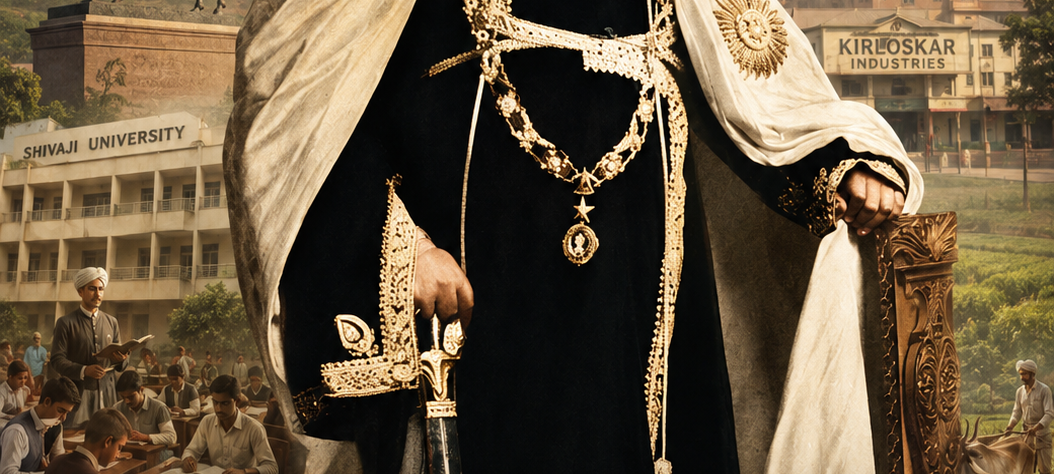
Strip away the garlands, and Chhatrapati Shahu Maharaj of Kolhapur turns out to be something more inconvenient than a reformer: India’s first working model of a welfare state, an experiment Maharashtra still lives inside and has half-forgotten how to read.
Every 26th of June, the bronze comes out clean. Across Kolhapur, Sangli, Satara and the sugar towns of western Maharashtra, men climb ladders to drape marigolds over the statues, the loudspeakers crackle to life, and politicians who agree on nothing else line up to claim a share of the same dead king. This year is no different. The speeches will praise Rajarshi Shahu Chhatrapati as the father of reservation, the man who reserved half the jobs in his little state for the backward castes a full forty-eight years before the Republic of India got around to writing such a thing into its Constitution. Garland, photograph, slogan, move on.
It is a strange kind of remembering that is also a forgetting.
Because if you actually walk the country he left behind — not the statues, the country — you keep tripping over him. The water in the canals of the Bhogawati valley is his. The cooperative that crushes the cane and the market that sells the jaggery grew from institutions he seeded. The Maratha boy who became a sub-divisional officer, the Dalit girl whose grandmother first sat in a classroom, the wrestler training in a hundred-year-old taleem — all of them are downstream of decisions taken in a palace between 1894 and 1922. We have reduced one of the most consequential governing minds in modern Indian history to a single policy and a public holiday. The policy was real. But it was never the point. It was a symptom of the point.
The point was this: long before India had a word for it, Shahu Maharaj governed as though the purpose of a state were the welfare of its weakest subjects, and as though social justice, irrigation, credit, schooling and industry were not separate departments but a single argument. He was not only the pioneer of reservation. He was the architect of a state. Maharashtra is what got built on the foundation, and the tragedy of our anniversaries is that we celebrate the architect while letting the building leak.
The man the priest would not crown properly
To understand why he thought the way he did, you have to begin with a humiliation.
In 1899, the young Maharaja discovered that the Brahmin priest of his own household, one Narayan Bhat, would not perform his religious rites using the full Vedic formulae. The reasoning, dressed in scripture, was brutally simple: Shahu was a Maratha, and Marathas, the priest insisted, were Shudras, not Kshatriyas, and therefore not entitled to the Vedic word. Here was the ruler of the state, a man descended in the popular imagination from Shivaji himself, being told by his own chaplain that he stood on the wrong side of a line he had not drawn and could not cross.
What followed is usually filed under the dry heading of the Vedokta controversy, and it is one of those episodes that historians of Maharashtra have argued over for a century. But its importance is psychological as much as political. Shahu had been raised partly in the British system — schooled at Rajkot, tutored in administration, conferred eventually with an honorary doctorate by Cambridge in 1903 — and he was temperamentally an empiricist, a man who trusted what worked over what was prescribed. The Vedokta affair taught him, in his own person, that the caste order was not a neutral inheritance. It was a machine for keeping power where it already sat. If it could humiliate a king, what was it doing to the carpenter, the weaver, the untouchable sweeper whose name no priest would ever bother to refuse?
From that wound grew a politics. Not a sentimental one — Shahu was never sentimental — but an administrative one. He concluded that the only way to break the monopoly of the few was to use the one instrument a ruler actually controls: the state itself, its jobs, its schools, its money, its laws. Everything that came after follows from that conclusion.
Why “father of reservation” is too small a phrase
So, yes, the order of 26 July 1902.
It is worth stating plainly what it did, because it is more radical than the holiday version. By proclamation, Shahu directed that of all the posts falling vacant in the Kolhapur state services from that day forward, fully half were to go to the backward classes — defined, with deliberate breadth, as everyone other than Brahmins, Prabhus, Shenvis, Parsis and the other “advanced” communities. Department heads were ordered to send him a report every three months. In one stroke he had taken an administration overwhelmingly staffed by a single educated caste and legally pried it open. <cite index=”1-1″>The order itself, in the official translation, stated that fifty per cent of vacant seats “should be filled with the backward classes.”</cite>
This was not, in 1902, a popular thing to do. It produced exactly the resentment you would expect from those who had treated public employment as hereditary property, and Shahu spent much of his reign absorbing that resentment.
But notice what the conventional account leaves out. Reservation, for Shahu, was the back end of a system whose front end was education, and whose purpose was economic. He understood something that Indian policy keeps relearning the hard way: that quotas without schools are a cruelty, because you cannot fill a post with a person you have refused to educate. He reportedly described free and compulsory primary education as the tonic that would let the lower classes throw off the dead weight of the past. The reservation was the promise; the schoolroom was how you kept it.
That is why it is historically incomplete, almost to the point of dishonesty, to remember him only for the quota. The quota is the part that fits on a placard. The system is the part that built a province.
A schoolroom in every village, and a fine for keeping the child out
Begin with the schools, because Shahu did.
In September 1917, Kolhapur did something no part of British India had managed: it made primary education free and compulsory for every child, of every caste, by law. And Shahu, who distrusted laws that were merely announced, enforced it the way a serious man enforces things. Parents who kept their children out of school could be fined a rupee a month — real money for a cultivator in 1917 — and the order set a deadline for enrolment. This was not the gauzy “right to education” of a modern statute that nobody is ever penalised for ignoring. It had teeth.
The money followed the rhetoric, which is the only test that matters. In the last years of his reign Kolhapur was spending something on the order of a fifth of its entire state budget on education. Read that again. A small princely state, not a rich one, putting close to a quarter of its money into the schooling of children most of whose parents could not sign their own names. Hold that figure against the education spending of governments that today carry his portrait into the legislature, and you begin to see why the anniversaries feel hollow.
But the schools alone would not have worked, because the children of the poor could not reach them. A boy from a Mahar or Mang or Mali family in a far village could not simply enrol in the town school; there was nowhere for him to live, and often nowhere he was allowed to eat. So Shahu built the thing that made the whole machine turn: hostels. He opened boardings — residential hostels — community by community, for the Marathas, the Jains, the Muslims, the Lingayats, the Sutars and Sonars and Shimpis, the Dhor-Chambhars, the Christians, the Panchals. Critics have noted, fairly, that organising them along caste lines risked hardening the very categories he claimed to despise. It is a real tension and worth naming. But the pragmatic logic held: a child needs a bed and a meal before he needs a theory, and the hostel system put thousands of first-generation learners within reach of a classroom in a single generation. Many of those boardings still stand. Some still function.
One of those hostel children is worth pausing on, because his life is the proof of concept. A Jain farmer’s son named Bhaurao Patil spent part of his boyhood as Shahu’s ward, living for a time in the Kolhapur palace itself, soaking up the Satyashodhak idea that learning belonged to the masses and not to the few. He grew up to found the Rayat Shikshan Sanstha and to coin a phrase — earn and learn — that put hundreds of thousands of poor rural children through school across the next half-century. Maharashtra calls him Karmaveer now. He was, in the most literal sense, a Shahu graduate. The king did not just open schools. He manufactured the people who would open thousands more.
“The mission of my life”: water as policy
If education was how Shahu freed people, water was how he fed them — and it is here that the modern reader, conditioned to think of irrigation, agriculture and industry as three separate ministries pulling in three directions, ought to sit up.
On 18 February 1907, on the Bhogawati river in the Sahyadri hills, Shahu set in motion the project he is said to have called the mission of his life: a great masonry dam at Radhanagari. The foundations went down in 1909. It was an audacious thing for a small state to attempt — a gravity dam swallowing eleven thousand hectares of forested hill, designed to drought-proof a district that had always lived at the mercy of the monsoon. He did not live to see it finished; the wall was completed only in 1935, thirteen years after his death, and it has run at full capacity since the late 1930s, watering some fifteen thousand hectares and powering and slaking the city of Kolhapur to this day.
Pause on the unsentimental detail of how it nearly went wrong, because it tells you what kind of state this was. After Shahu’s death there was a serious proposal to convert the scheme into a thermo-electric and mining venture — to send the water down to the Konkan to spin turbines for a British industrial syndicate, rather than spread it over the fields of Kolhapur. An engineer, Pandurang Shinde, argued that the water belonged in the soil of the people who lived above it, and the irrigation purpose was preserved. The dam stayed a farmer’s dam. That choice — water for cultivators over water for a distant syndicate’s profit — is the whole Shahu philosophy compressed into a single administrative decision.
And crucially, the dam was never a stand-alone monument. It was one node in an integrated agricultural design that would not embarrass a modern development economist. Around 1912 Shahu set up the King Edward Agricultural Institute to teach scientific cultivation — better seed, better method, higher yield. He made credit available to farmers who wanted to buy modern implements, understanding, decades before the term existed, that a peasant without capital cannot modernise no matter how clever the technology. He encouraged the iron plough over the wooden one. He pushed cooperative societies so that small cultivators could pool what individually they lacked. And he built the markets where the produce could actually be sold.
Look at what that adds up to: water, science, credit, cooperation, market — applied as one policy, to one problem, in one place. We have spent the seventy-odd years since Independence carefully separating those five things into rival departments that compete for budgets and blame each other for failure. Shahu treated them as a single sentence with five clauses. The cane fields and sugar cooperatives that made western Maharashtra the richest agrarian belt in the state did not appear from nowhere in the 1950s. They grew in soil he had irrigated, on credit habits he had taught, through cooperative forms he had legitimised.
The plough, the mill, and the king who rescued Kirloskar
Now, the industry — and here a story Maharashtra loves to tell deserves its full shape rather than half of it.
It is often said, in the anniversary speeches and the WhatsApp forwards, that Shahu Maharaj gifted Laxmanrao Kirloskar the thirty-two acres of wasteland on which the famous industrial township of Kirloskarwadi rose. In fact that land — at a nominal price, with an interest-free loan — was granted in 1910 by Balasaheb Pant Pratinidhi, the Raja of Aundh, after the Belgaum municipality evicted Kirloskar from the town. The Kirloskar Brothers works still stands on that soil.
But the land is not where the Shahu–Kirloskar thread actually runs, and the real bond is of a different and more telling kind. Shahu was a protector of entrepreneurs in trouble, and one such rescue went to Laxmanrao Kirloskar. It was the time of the First World War, two years in, no end in sight, and with imports and exports collapsing the Kirloskar factory ran short of the one thing it could not work without: the iron to forge its agricultural implements. A maker of ploughs with no iron for ploughs — a squeeze that could have killed a fledgling indigenous industry where it stood. And it was the ruler of the Deccan, Rajarshi Shahu of Kolhapur, who came to his aid at exactly that moment, broke the iron deadlock, and kept the works running.
That help was not a stray act of charity; it came out of a settled conviction. He had started the Shahu Chhatrapati Spinning and Weaving Mill back in 1906 — a textile mill explicitly built to give people work, to keep money and employment inside the state rather than exporting both to Manchester. A Kirloskar works did in fact operate at Kolhapur too; the young Bhaurao Patil, the future Karmaveer, drew a wage there while organising for the Satyashodhak cause. The iron plough that Kirloskar was struggling to sell to superstitious farmers who thought metal would poison the soil was exactly the implement Shahu’s agricultural institute was teaching cultivators to trust. At one end, the entrepreneur forging the tool; at the other, the state coaxing the farmer to accept it; and in the wartime crisis between them, the same king steadying both.
So the land may have come from Aundh, but when Kirloskar’s enterprise was about to buckle under the wartime squeeze, the hand that steadied it was Shahu’s — and that is more revealing than any gift of land. Because it was not a favour to one industrialist; it was a stance. He was one of a small clutch of Indian rulers who decided, before there was any nationalist consensus on the question, that the job of a state was to build an economy and rescue it in a crisis, not merely to tax one. We have a phrase for incentivising a manufacturer, propping him up when he stumbles, retaining the value chain locally, training the workforce and seeding the supplier network: we call it industrial policy, and we hand out glossy reports and “investor summits” about it. Shahu was practising it, in fact if not in vocabulary, while Edward VII was on the throne.
Shahupuri: an investor’s town before there was an investor class
The clearest single artefact of that mind is a market.
Shahu laid out a trading and commercial quarter — Shahupuri — and a dedicated market for jaggery, the gur on which the local cane economy turned. This sounds modest until you think about what a market actually is: a place where the state guarantees the rules so that strangers can trade with each other in confidence. By building the physical market, fixing where the cane and gur would change hands, connecting it to the railway, and surrounding it with cooperatives and credit, Shahu was doing the unglamorous backstage work that makes commerce possible. He was reducing what an economist would now call transaction costs.
Set this beside the rest of his infrastructure and a pattern resolves. He pulled the railway and a proper station to Kolhapur, knitting the state into the wider economy. He laid roads. He brought in the telephone. When plague and famine struck — and they struck hard in those decades — he ran relief works, transit camps and quarantine arrangements, the apparatus of a state that takes responsibility for its people’s survival rather than treating catastrophe as fate. None of this was charity in the alms-giving sense. It was a deliberate effort to make Kolhapur a place where a farmer could grow, a trader could sell, a manufacturer could build and a worker could find a wage — and to make all of that legible, predictable and safe.
We would call that an enabling environment for investment. We would call the man who created it investor-friendly. The uncomfortable thing, for a present that fetishises exactly this language, is that he did it without a single PowerPoint, and he did it while simultaneously demolishing the social hierarchies that today’s “ease of doing business” rankings politely decline to mention. Which is the deeper reason Kolhapur became, and stayed, one of the strongest regional economies in Maharashtra. It was not luck and it was not only the river. It was that a ruler treated economic development and social justice as the same project, run from the same desk, aimed at the same people.
Social democracy, drafted in a palace
It is when you turn to the social legislation that the phrase “ahead of his time” stops being a cliché and starts being a literal description.
Consider the calendar. On 1 January 1917, Kolhapur legally sanctioned the remarriage of Hindu widows — a frontal assault on one of the cruellest customs of the age. On 12 July 1919, the state legalised inter-caste and inter-religious marriage, putting the protection of the law behind couples who married across the lines that the entire social order existed to police. On 11 November 1920, Shahu moved against the Devadasi system, the religiously sanctioned sexual exploitation of women dedicated to temples. He pushed the education of girls, endowed scholarships in his mother’s name for women students, and trained women as teachers so that there would be someone to teach the next generation of girls. He opened Sanskrit and Vedic instruction to all castes and trained non-Brahmin priests, attacking the religious monopoly at its root rather than merely complaining about its effects.
And he went after bonded servitude. The hereditary vatan system bound whole communities — the Mahars above all — to unpaid, compulsory service to the village, a slavery dressed up as tradition and custom. Shahu moved to abolish that hereditary obligation, to break the chain that tied a man’s labour to his birth for the convenience of those above him. He did the same for the so-called criminal tribes, communities the colonial state had branded hereditary criminals and forced to report to the police like parolees for the accident of being born. Near Kolhapur, at Sonatali, Shahu set up a settlement that treated these people not as suspects but as citizens to be rehabilitated, handing them looms and ploughs and carpentry tools and, the accounts insist, the thing the colonial label had stolen: the right to be regarded as ordinary, dignified human beings rather than criminals by blood.
String these acts together — widow remarriage, inter-caste marriage, the assault on Devadasi exploitation, women’s education, the breaking of bonded labour, the rehabilitation of the criminalised, the throwing-open of religious learning, the reservation in services, the free compulsory school — and you are not looking at a charitable raja with a soft heart. You are looking at a man drafting, statute by statute, the social content of a democratic constitution, thirty years before India had one. Strip away the throne, and the programme is recognisably that of a social democrat. He could not call it that. The vocabulary had not arrived. But the thing was there.
Ambedkar at Mangaon, and why Kolhapur gave the movement its nerve
Which brings us to the meeting that historians keep returning to, and should.
In March 1920, in the village of Mangaon inside Kolhapur state, a conference of the depressed classes was held, and the chief guest was the Maharaja. The man presiding over it was a young, almost unknown scholar recently returned from his studies abroad: Bhimrao Ambedkar. Shahu attended not to lend royal lustre to the occasion but to point, publicly, at this particular young man and say, in effect: here is your leader, follow him. He had spotted in Ambedkar what he could no longer be himself — a leader of the oppressed who came from the oppressed, who would not need a king’s permission to fight.
The support was not rhetorical. When Ambedkar launched his newspaper Mooknayak — “the leader of the voiceless” — in 1920, Shahu’s money helped pay for it. He had backed Ambedkar’s education and would back his cause. This matters enormously to the larger argument, and not for sentimental reasons. The conventional story makes Shahu the precursor and Ambedkar the fulfilment, two great men in a relay race of social justice. The deeper truth is structural. Kolhapur was a place where the movement could find its feet because the apparatus already existed — the schools that had produced literate Dalit youth, the hostels, the public sanction for assault on caste, the simple, world-altering fact of a state that was on their side rather than against them. A movement needs more than a leader. It needs ground to stand on. Shahu had spent twenty-five years making the ground. Ambedkar, who would later call the king a pillar of social democracy, knew exactly what he had been handed and where it had come from.
The questions the anniversaries are designed to avoid
Now the hard part, because a serious account of Shahu owes him honesty rather than incense, and the incense has become a way of not thinking.
He was an autocrat. Everything described here was done by command, from the top, in a state small enough for one determined man to remake by will. It was benevolent autocracy, but it was autocracy, and a programme that depends on the personal conviction of a king is structurally fragile — which is partly why the dam took thirteen years after his death to finish and why the integrated vision frayed once the visionary was gone. His anti-Brahmin politics, however justified as a response to a genuine monopoly, carried its own hardening of categories, and the caste-organised hostels he built to widen opportunity also, arguably, entrenched the lines they were meant to dissolve. None of this cancels the achievement. All of it should keep us from worshipping rather than learning.
But the honesty cuts hardest the other way — against us, not him. Three questions hang over every garlanded statue this 26th of June, and we have arranged our remembrance precisely so that they never get asked.
Why do governments that cannot get through a sentence without invoking Shahu Maharaj celebrate his reservations and ignore his economics? The reservation is safe to praise because it has hardened into vote-bank arithmetic, a thing you distribute and count. The economics — the schools funded at a fifth of the budget, the dam, the credit, the cooperative, the market, all aimed together at lifting the poorest into producers — is dangerous to praise, because praising it would oblige you to do it, and doing it is expensive and slow and wins no election by Friday.
Why has social justice been allowed to shrink into a slogan? Shahu’s social justice was infrastructural. It was a school you could be fined for not using and a hostel bed and a job that followed the schooling and a market that followed the job. Ours is too often a hashtag, a statue unveiling, a commemorative postage stamp — the symbols of his project carefully detached from its substance. He built institutions of justice. We hold functions about them.
And why have we dismantled the one insight that was most original to him — that irrigation, agriculture and industry are a single integrated policy? In Shahu’s Kolhapur the water, the trained farmer, the credit, the cooperative, the mill and the market were one continuous thought. In modern Maharashtra they are six warring departments, six budgets, six ministers, six sets of consultants, and the farmer who is supposed to be the point falls through every crack between them. We did not just fail to build on his model. We took the one thing he had welded together and carefully sawed it back apart.
A foundation, not a portrait
There is a temptation, writing about a figure like this, to end on a swell of uplift — the visionary king, the light that still shines, and so on. Shahu would have despised it. He was a builder, not a saint, and builders are judged by whether the building stands.
His does. That is the genuinely remarkable thing. A century after his death, the foundations he laid are still load-bearing. The cooperative economy of western Maharashtra, the educational ladder that lifted whole communities into the middle class, the reservation principle that the Indian Constitution would later make national, the very idea that a state exists to make its weakest people into producers and citizens — these are not relics. They are infrastructure, and millions of lives are still standing on them, mostly without knowing whose name is on the foundation stone.
The danger was never that we would forget Shahu Maharaj. We remember him obsessively, in bronze. The danger is that the remembering has become a substitute for the governing — that we have learned to honour the portrait so we are spared the harder work of inhabiting the example. He gave Maharashtra a working theory of the state: that justice and prosperity are one task, run from one desk, owed first to the poorest. The theory is still sound. The water still flows. The schools still teach. The cooperatives still crush the cane.
What Maharashtra needs from Shahu Maharaj this June, and every June, is not another garland. It is the nerve to govern the way he did. He left a state, fully drawn and largely built. We have been living in it, neglecting the maintenance, and putting flowers on the architect.