
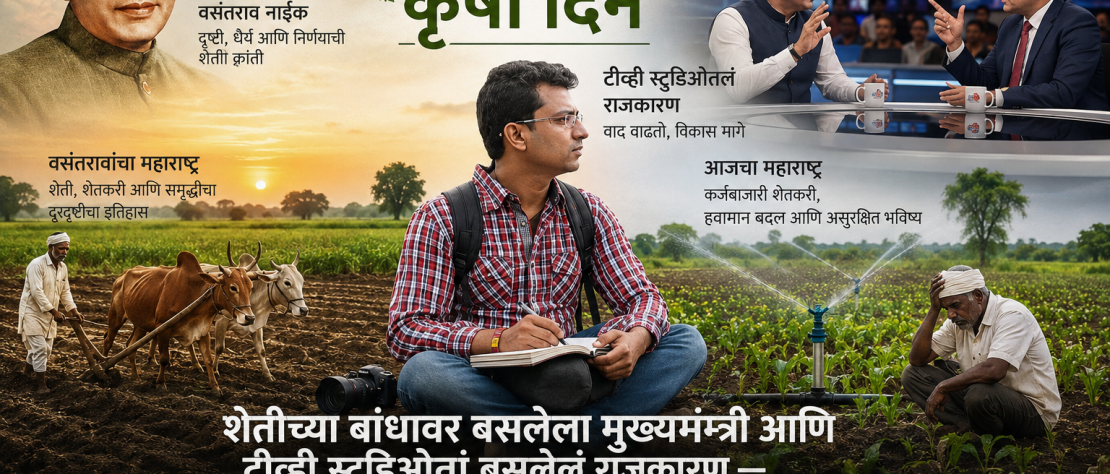
A journalist’s sixteen-year witness to how Maharashtra’s politics drifted from the soil to the screen
Every year, before Vasantrao Naik arrives in memory, the rain arrives first.
The clouds gather in the days before Ashadhi Ekadashi, not yet breaking, just gathering — and the soil begins to carry that particular smell that no one born in a city ever quite learns, but that lives permanently in the blood of anyone born to a farming household. It is in the middle of these days, on the first of July, that a boy was born in 1913 in a small village called Gahuli, in Pusad taluka of Yavatmal district, to Fulsing Naik, a Banjara community leader. Nobody in Gahuli that day could have known that this boy would go on to carry Maharashtra’s chief ministership on his shoulders for eleven unbroken years — a record no successor has matched since.
I received the Vasantrao Naik Krishi Patrakarita Award in 2009. It felt like an honour then, and it still does. But over sixteen years of attending that ceremony nearly every year, the feeling has changed shape. What I carry now is not pride but its quieter, heavier cousin — responsibility.
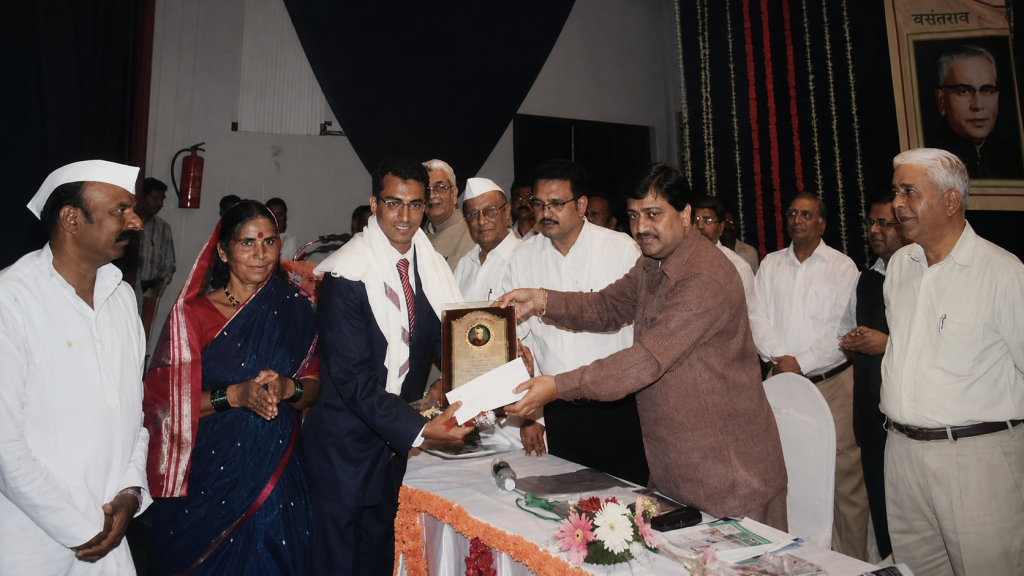
In the earlier years, that stage held real intellectual weight. Agricultural economists spoke with data. Scientists spoke about soil. Farmers who had actually experimented in their own fields stood up and argued with policymakers. Somewhere along the way — not suddenly, but the way a river changes course grain by grain — that weight thinned out. The speeches got louder. The data got thinner. What I’ve watched, ceremony after ceremony, is agriculture slowly disappearing from an agricultural award function.
Naik himself was the son of Gahuli’s harsh geography — a village caught between the hottest summers and coldest winters in the region. He studied in fits and starts across Poharadevi, Bhojla, Umri, Amravati, finally taking his law degree from Nagpur. He married Vatsalabai Ghate, from a prominent Brahmin family, in 1941 — an inter-caste marriage that drew resistance from both sides, resistance his composure eventually dissolved. The 1942 Quit India meeting in Bombay pulled him into Congress politics, and by December 1963, following the sudden death of Chief Minister Marotrao Kannamwar, Naik was sworn in as Maharashtra’s Chief Minister — a post he held until February 1975.
It was Naik who renamed his official bungalow — a modest structure previously called “Dug Began” — as “Varsha,” because rain was the subject closest to his heart. That bungalow remains the Chief Minister’s official residence to this day.
His declaration at Shanivarwada in Pune in October 1965 — that if Maharashtra did not become self-sufficient in foodgrain within two years, he should be hanged before that very fort — is remembered as rhetoric. It was not. It was a policy commitment backed by hybrid seed distribution, four new agricultural universities, and an irrigation philosophy of “hold the water, let it seep in” — and by 1970, Maharashtra had, in fact, become self-sufficient.
The Employment Guarantee Scheme, born out of the catastrophic 1972 drought, remains his most enduring institutional legacy — the first scheme of its kind in India, built on the principle that anyone asking for work should get it, and payment with it. The Cotton Monopoly Procurement Scheme of 1971 freed cotton growers from the grip of brokers. The Panchayati Raj framework he helped design decentralised power down to the village and produced, over decades, a generation of rural leaders who went on to become chief ministers themselves.
What strikes me most, returning to his story now, is not the scale of his schemes but the register of his language. When economists criticised the Employment Guarantee Scheme as inflationary, his answer wasn’t defensive — it was blunt: if you cannot give the farm labourer work, at least don’t pretend there’s a cleaner alternative. That kind of directness, that willingness to own the consequences of a promise publicly and specifically, is what I find myself missing most on today’s platforms.
Today’s agricultural discourse in Maharashtra is not absent — it is simply elsewhere. It happens in television studios, in social media branding exercises, in electoral arithmetic. Climate volatility, water stress, export barriers, precision farming, the agri-startup ecosystem — these rarely surface at the very functions meant to honour agricultural achievement. What surfaces instead is politicians discussing each other.
The crisis today is more dangerous than the one Naik faced, precisely because it is structural rather than seasonal. His drought had a beginning and an end; today’s uncertainty — climate volatility, rising input costs, fragmenting landholdings, a generation opting out of farming altogether — has no clear resolution in sight.
My own difficult conclusion, after years of covering this beat, is this: our next generation should not sell the land; but neither should its future depend on the land alone. That is not cynicism. It is the shape hope now has to take.
The rain will come, as it always does. The real question is whether the farmer waiting for it still carries the confidence Vasantrao Naik once tried, however imperfectly, to build in him.
Vijay Gaikwad, Mumbai