
A Long Inquiry: Superstition, Rationalism and the Indian Mind’s Journey
— Vijay Gaikwad
One: The Sky That Morning
It was the morning of September 21, 1995.
I was a student in my village — Takali Dhokeshwar in Parner taluka — studying in the tenth standard. The first great threshold of life was yet to be crossed. At that age, there was the anxiety of exams, a hazy fear of the future, and an immature, insatiable curiosity about the world.
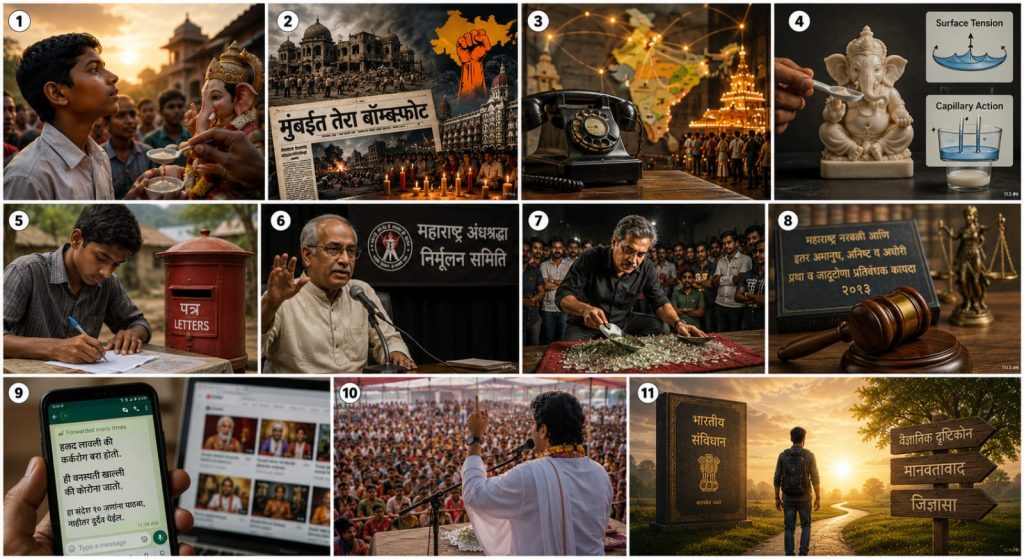
That morning, before entering the classroom, someone announced: “Ganesha is drinking milk! All over the country! It happened in Delhi, it happened in Mumbai, now it’s happening here too!”
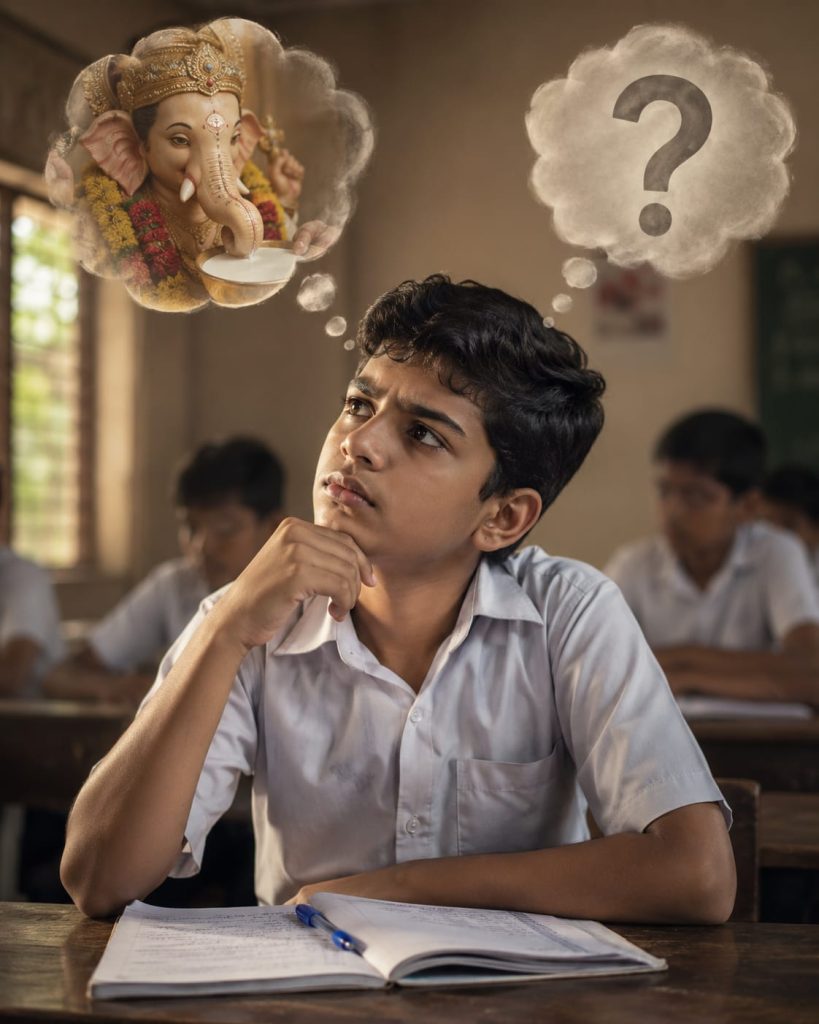
My first thought: Really?
The second: How is that possible?
And the third — the one that was difficult to arrive at, at that age — Why is this happening?
I stepped out of school. In the neighbourhood, there was a Ganesha temple. A crowd had gathered. Someone was offering a spoonful of milk to the idol, someone was weeping, someone stood with folded hands. An uncle pulled me toward it — “Look, it’s really drinking, look!” I looked. The milk from the spoon moved slowly toward the idol’s lips and… seemed to go inside.
In that moment, a war broke out within me. Thirty years on, that war is not over.
Two: Mud Over a Wound
To understand India in 1995, you have to begin in 1992 and 1993.
December 6, 1992. The Babri Mosque in Ayodhya was demolished. The riots that erupted across the country killed thousands. In Maharashtra — especially Mumbai — violence raged through January 1993. The Srikrishna Commission later recorded: over 900 deaths, the majority Muslim.
And then — March 12, 1993.
Thirteen bomb blasts in Mumbai. The Stock Exchange, Century Bazaar, Zaveri Bazaar, the Air India Building… 257 killed in a single day. Over a thousand injured. Those explosions did not merely destroy buildings — they destroyed a belief rooted deep in the Indian citizen’s mind: We are safe.
For two years after, Maharashtra lived with a deep collective wound. Society was broken somewhere inside. People were gripped by fear. Weighed down by uncertainty. What does a human being do in such moments? He goes in search of something to hold on to. And the oldest, most familiar support is — God.
In March 1995, the Shiv Sena-BJP alliance came to power in Maharashtra. Balasaheb Thackeray, L.K. Advani, Manohar Joshi — these faces now held sway. The political hue of Hindutva had grown darker. Temple-mosque, God-religion, nation-culture — the political use of this language had never before been so intense.
In this atmosphere — of religious insecurity, political identity, collective wound — one September morning, from somewhere, a cry rose: Ganesha is drinking milk.
This was not a coincidence.
Three: The Geography of a Rumour
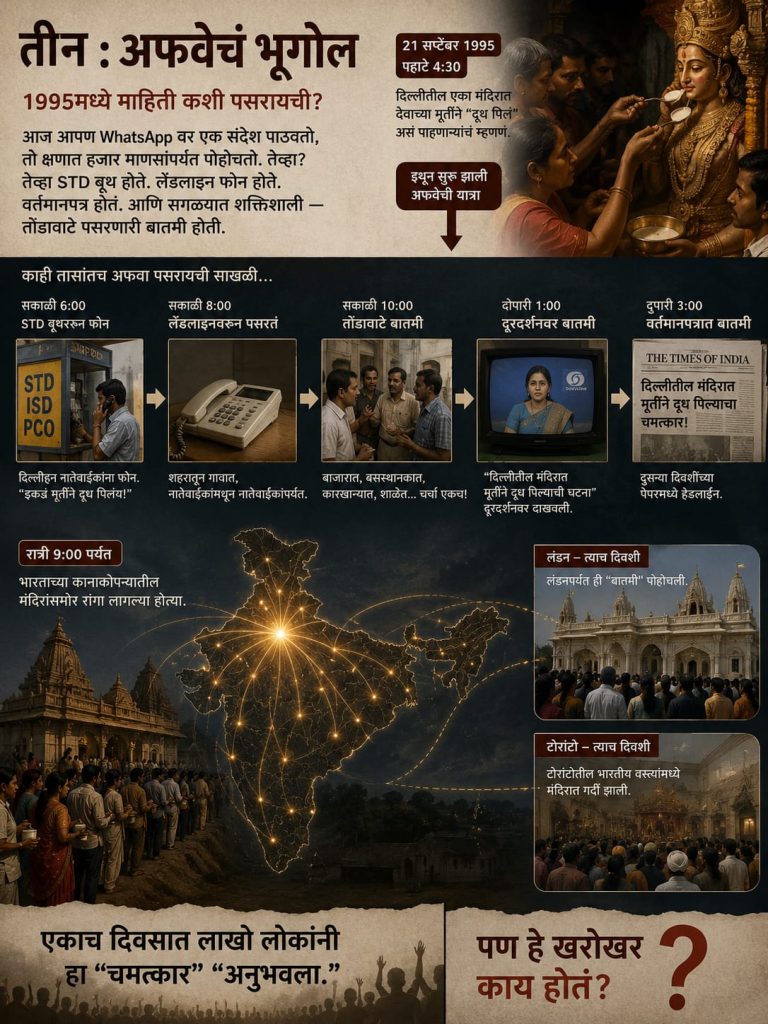
How did information spread in 1995?
Today, we send a message on WhatsApp, and it reaches a thousand people in an instant. Back then? There were STD booths. Landline phones. Newspapers. And the most powerful of all — news that spread by word of mouth.
In the early hours of September 21, this “news” began from a temple in Delhi. Within hours, it travelled across the country through the wires of STD booths. By afternoon, Doordarshan had broadcast it. Newspapers picked it up. And by nightfall, queues had formed outside temples in every corner of India.
The news reached Britain, America, Nepal. In Toronto, crowds gathered at temples in Indian neighbourhoods the same day. In a single day, millions of people had “experienced” this “miracle.” One Marathi newspaper titled its editorial that day: “A Day of Darkness.” It wrote: “The belief that learning makes people wise was demolished in an instant… satellites sent into space dissolved into space; what remained was only the frenzy, the collective stupor, and the crowds of the faith-possessed at temples.”
That description was as true as it was heartbreaking.
But what was actually happening?
Physics gives the answer: Surface Tension and Capillary Action.
The surfaces of idols made of marble, brass or stone have microscopic pores. When milk is held to an idol’s lips with a spoon, the liquid’s surface tension and capillary action cause the milk to spread slowly across the idol’s surface. The movement is so gradual that the eye perceives it as going “inside.”
This was demonstrated by science enthusiasts on the very same day. Some used plastic dolls to show the same effect. The workers of Maharashtra Andhashraddha Nirmulan Samiti (MANS) took to the field immediately and exposed it through live experiments.
But even more significant was the psychological phenomenon of Mass Hysteria.
When the social mind is already under strain, when people are yearning for a miracle, when thousands gather and look in the same direction — the brain sees what it wants to see. Confirmation Bias. Crowd Psychology. This is not deception — this is the architecture of the human brain.
That day, millions of people were not lying. They were genuinely “seeing.” But what they were seeing was not reality — it was a picture painted by their own minds.
And one question — whose answer has never been found: Where, exactly, did this rumour originate? Who were the architects behind its spread? Whose interests were served? MANS demanded an inquiry into these questions. That “mystery” remains unsolved to this day.
Four: Courage at Sixteen
A few days later, I returned home. In Takali Dhokeshwar, the talk in the village was still only about that event. “Lord Ganesha is pleased with us,” the elders were saying. Some had even directly connected it to the political developments of the time — the alliance government coming to power, the rise of Hindutva.
My mind, however, was filled with different questions.
That week, I wrote a letter. To a newspaper. By hand. With a blue-ink pen. Nobody in the village knew about it, I told no one. I dropped it in the post. There was one hope — that it would be printed. But there was fear too — what will people say?
In that letter, I had written about surface tension, about capillary action. I had written that this was not a miracle, it was science. I had written that such events diminish society’s faith in scientific thinking.
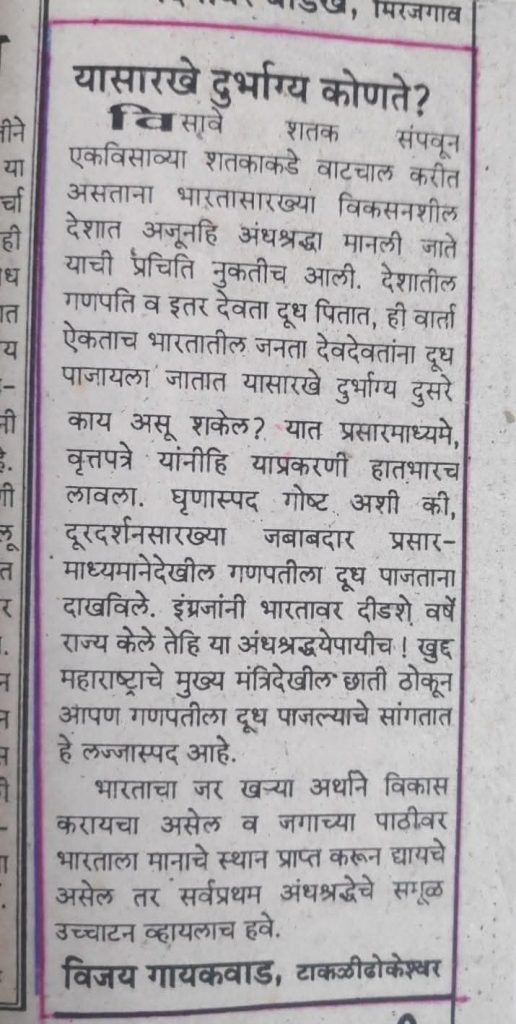
Whether that letter was published — I don’t quite remember now. But some years ago, buried in a pile of old notebooks, I found a clipping. Yellowed, edges worn. My own name on it — ‘Vijay Gaikwad, Parner.’ And below it, those thoughts — from that sixteenth year.
Reading that clipping, my eyes filled with tears. I did not cry for that boy — I cried because, thirty years later, there is still occasion to ask the same questions.
In rural Maharashtra in 1995, taking a rationalist stance was not easy. The village was small. Challenging religious devotion meant questioning society directly. It meant hurting one’s family. It meant standing alone. There were those who said, “The boy has gone astray.” There were those who dismissed it with, “He’s become an atheist.”
But at that very time, in Maharashtra, there was a man who was fighting all of this alone. Who was receiving threats, yet would not stop.
His name was — Dr. Narendra Dabholkar.
Five: One Man, One Fight
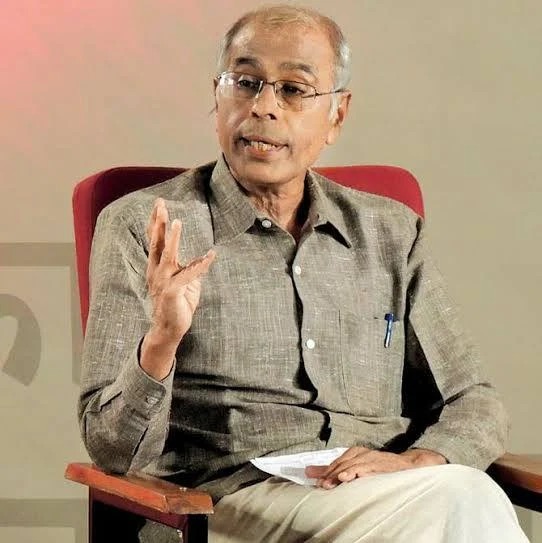
To call Dr. Narendra Dabholkar merely an “anti-superstition activist” would be a profound understatement.
He was a trained physician. But he chose to fight the mental illness of society rather than practise medicine. This man from Satara district, from the Mandesh region, traversed Maharashtra. He went village by village and exposed “miracles.” Rituals of exorcism, the devadasi practice, human sacrifice, black magic — against all of these, he waged a relentless struggle.
Maharashtra Andhashraddha Nirmulan Samiti (MANS) — the organisation he built in 1989. Thousands of workers across Maharashtra worked alongside him. He did not merely give lectures — he demonstrated through experiments. He exposed the trickery of godmen. He showed people how “magic” works. He made efforts to free women living in bonded servitude under the name of “God’s service.” It is because of Dabholkar that MANS, every year, observes September 21 as “Miracle Truth-Seeking Day” — to keep the memory of the Ganesha milk-drinking episode alive, and to show society the path of rationalism.
Political attacks were launched against him. He was called “anti-Hindu,” “atheist,” “a traitor to culture.” Some sent him death threats.
But Dabholkar did not stop.
And then — August 20, 2013.
Dr. Dabholkar, who had stepped out for a morning walk on Omkareshwar Bridge in Pune, was stopped by two bullets. Two armed men fired at close range. He died on the spot.
That day, Maharashtra was shaken.
“We cannot kill a thought” — millions said this after his assassination, taking to the streets. But alongside, a burning question remained: Who killed him? Who gave the order? That question remains unanswered in court even now — over a decade has passed. The architects of the Ganesha milk rumour remained unknown; the masterminds of Dabholkar’s assassination remained unknown — there is a terrible parallel between these two silences.
After Dabholkar’s assassination, a bill was moved in the legislature. Maharashtra got a law. The law he had fought for through years of his life was passed after his death — this is one of the bitter histories of Indian democracy.
Six: Shyam Manav — The Surgeon of Miracles
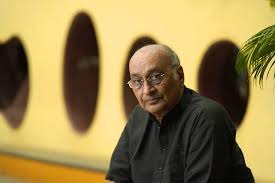
Parallel to Dabholkar, another man was doing this same work in Maharashtra — Shyam Manav.
Manav’s method was different. He directly challenged those who claimed to perform “miracles.” “You say you have divine powers? Demonstrate it through experiment.” He walked on fire, rolled on glass — and then explained the science behind it. “You can do this. There is no God in it, there is training.”
He exposed the fraudulent miracles of hundreds of “buwas,” “babas,” and “matas.” In rural Maharashtra, he would walk alone to a gathering, conduct experiments in the pandal, make people laugh, make people think.
He received threats. He was beaten. On one occasion, he was physically attacked.
But he would say: “I am not against religion. I am against the exploitation of human beings. Everyone has the right to hold faith. But if fraud is being committed in the name of that faith, then stopping it is my work.”
He would always clearly articulate the distinction between religion and superstition — “Bathing in a river is faith. But charging money while telling someone ‘if you don’t bathe in this river, you will fall ill’ — that is superstition. One is a person’s right; the other is exploitation of that person.”
Seven: The Law and Its Enemies
After Dabholkar’s decades-long struggle, after his assassination, the “Maharashtra Prevention and Eradication of Human Sacrifice and other Inhuman, Evil and Aghori Practices and Black Magic Act” came into existence. This law was passed by the Maharashtra Legislature in December 2013.
What did the law prohibit?
Human sacrifice, fraud under the pretext of black magic, exorcism, causing physical harm in the name of God, taking money by making false claims of “healing through magic” — all such acts were made punishable.
What did the opponents say?
“This law is anti-Hindu.” “It criminalises Hindu traditions.” “It is an attack on religious freedom.”
But these allegations were false. Because no religion is mentioned anywhere in the law. Performing puja, observing fasts and vows, going on pilgrimage — none of this is prohibited. It is only those acts that cause physical harm to a person, those acts that involve financial fraud, those acts that exploit the vulnerable sections of society — especially women — that are banned.
Article 51(A)(h) of the Indian Constitution is clear: “It shall be the duty of every citizen of India to develop scientific temper, humanism and the spirit of inquiry and reform.”
The practical impact of the law? Some exorcist godmen were arrested in certain places. Some cases went to trial. But enforcement is inadequate — this is the truth. The police machinery lacks sensitivity. The judicial process is slow. And most importantly — social transformation does not happen through law alone. Dabholkar himself used to say: “A law is one tool; the real battle is in the human mind.”
Eight: The Rise of WhatsApp University
After 2013, India changed. And with it, the form of superstition changed too.
Once, rumours spread from STD booths. Now they spread on WhatsApp. Once, “darshan” would happen at a godman’s ashram. Now it is live on YouTube. Once, a “miracle” would happen in some village. Now it reaches crores of people within minutes.
WhatsApp University — this phrase has now become common currency. But understand its depth. In rural India where education has not reached, where media literacy does not exist, WhatsApp is the only university. And this university has no curriculum, no faculty, no fact-checking mechanism.
“Applying turmeric cures cancer.” “Eating this plant removes COVID.” “Chanting this mantra will bring success in exams.” “Forward this message to ten people, or misfortune will befall you.”
This is not just in villages. This is forwarded in the groups of highly educated corporate employees in Mumbai. Because education and discernment are two different things — this is something we are yet to understand.
On YouTube, channels of “babas,” “maharajas,” and “matas” have millions of subscribers. A news channel may not have the audience that a single “spiritual guru’s” channel commands. The algorithm plays a decisive role in this — watch one piece of religious content, and YouTube keeps pulling you in that same direction.
TRP and the commerce of religion — these are now so intertwined that separating them is difficult. Running a news channel requires money, money requires TRP, TRP requires sensational content — and what is more sensational than religion, superstition, miracles?
Fake News is not merely political dishonesty. “If you don’t eat this, your life will be shortened” or “This ritual will bring wealth” — this too is Fake News. Except it never surfaces on fact-checking websites.
Nine: Bageshwar Dham — Modern Miraclism
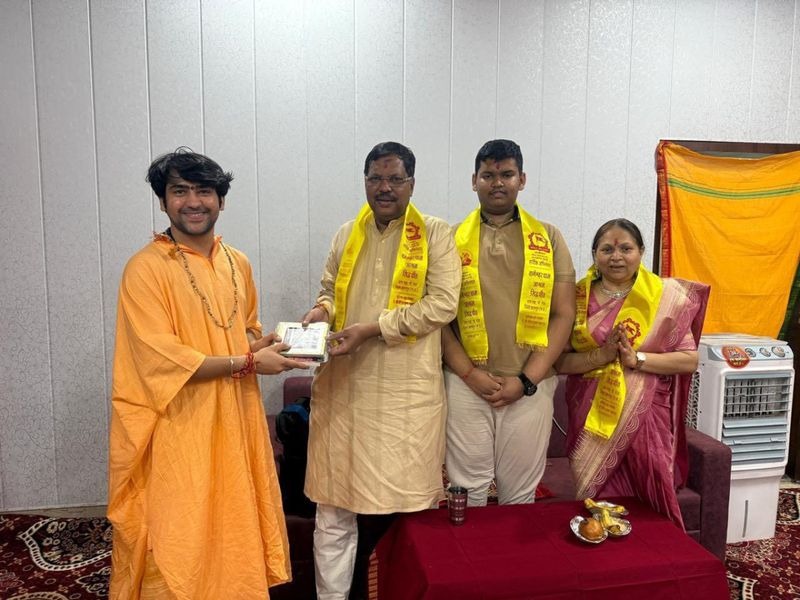
Between 2023 and 2025, a name from Chhatarpur district in Madhya Pradesh echoed across India — Bageshwar Dham.
Dhirendra Krishna Shastri. A young man barely in his thirties. White dhoti, saffron on his brow, a book in hand, and a confident smile. Lakhs of devotees come to his programme — the “Divya Darbar.” He claims that he has the grace of “Balaji Bajrangbali,” that he can read minds, heal the sick, tell the future.
Look at his method and you see the religious coating of Mentalism, Cold Reading and Hot Reading. Information about attendees is gathered before the programme. That information is then presented as “divine vision.” This is a craft of illusion — thousands of mentalists around the world do exactly this. The only difference is that they do it as art; Shastri does it as “God’s grace.”
Here, an old saying of Sathya Sai Baba comes to mind. He used to refer to his miracles in modern terms as “visiting cards” — in essence, miracles were the means to draw devotees near; the real purpose lay elsewhere. In the “Divya Darbar” of Shastri, the same formula seems to be at work.
In Maharashtra, workers of MANS issued a challenge to Shastri in Nagpur. “Come, let us test your claims under controlled conditions.” Shastri did not come. But his popularity did not diminish.
Why?
Because the people who come to him are not looking for “evidence.” They are looking for “hope.”
A mother with cancer comes, seeking a cure. A bankrupt farmer comes, seeking something to feed his children. A young man comes — no job, no love, no path — seeking anything at all. Give these people science, they will not listen — because science does not wipe their tears at this moment, right now. Bageshwar Dham does.
That is a lie — but it is deeply human.
And this is the real root of superstition: Helplessness.
Ten: The Bench and the Shrine
In 2025, a piece of news arrived that unsettled many.
Chief Justice of India Bhushan Gavai paid a visit to Bageshwar Dham.
Justice Gavai rose from the Dalit community to the pinnacle of the judiciary. His struggle is inspiring. His legal sharpness is well known. And it was precisely for this reason that his visit to Bageshwar Dham raised many questions.
Supporters said: “This is his personal faith. As a human being, he has the right to go anywhere.”
Critics said: “He is the CJI. He is the symbol of India’s judiciary. His visit carries symbolic weight. Tomorrow, if someone approaches the court with a case against that Baba, how can one expect justice to be impartial?”
This is a difficult question.
The Indian Constitution grants religious freedom — Article 25. At the same time, those who hold constitutional positions carry an unwritten responsibility: to protect the image of the institution. A judge does not meet a litigant privately — even if the intention is entirely innocent. Why? Because “justice being done” and “justice being seen to be done” — both are essential.
When Dhirendra Shastri says “I have divine power, I heal people” — and when legal cases have been filed, and can be filed, against these claims — what is the symbolic weight of the CJI of India visiting that place?
This is not saying “the CJI is wrong.” This is asking a question about institutional ethics.
This tension between personal faith and public office is a permanent question in modern democracy. Politicians go to temples — and publish the photographs. The Prime Minister performs rituals — they are broadcast on national media. Judges go on pilgrimages. In all of this, where does “personal faith” end and “public institution” begin?
We must keep asking this question. The answer is not simple — but stopping the asking is not an option.
Eleven: Why Does Superstition Survive in the Age of Science?
We must ask ourselves this question. And the answer is not simply “people are foolish” — because that is neither true nor sufficient.
First reason: Helplessness and the need for control.
Human beings need control — over their own lives, over their circumstances. When a job is lost, illness strikes, drought hits, a child’s problem remains unsolved — a person becomes helpless. The remedy for this helplessness is to surrender oneself “into someone’s hands.” Buwas, babas, maharajas — they provide exactly this: the illusion of control. When there is someone to say “do this and that will happen,” the mind feels lighter.
Second reason: Neither rich nor poor, neither educated nor uneducated.
IIT engineers break down walls for Vastu Shastra. MBA holders check the “muhurta” before starting a new business. Doctors recite specific mantras before surgery. This means education is not the cure for superstition — because education and rationalism are two different things. If you learn engineering but not critical thinking, then you may have a degree and still carry superstition.
Third reason: The alliance of religion and politics.
When religion receives political support, when godmen receive a politician’s blessing, when gods and goddesses are used in election campaigns — superstition receives a kind of “state legitimacy.” “The government supported it, so it must be right” — this logic is indefensible, but it works.
Fourth reason: The insecurity of the middle class.
India’s middle class has risen economically but is psychologically unstable. There is EMI, there is competition, there is children’s admission, there is illness, there is anxiety about retirement. This class searches most desperately for “solutions” — and is most easily deceived.
Fifth reason: Media’s refusal to accept responsibility.
TV channels, YouTube, WhatsApp — if they show and amplify sensational religious content, the responsibility is also theirs. “We only show what people want to see” — this answer is not enough. Tobacco companies used to say the same thing.
Twelve: Yet There Is Light
But in saying all of this, one thing must not be forgotten.
The rationalist tradition built in Maharashtra by Phule, Shahu, and Ambedkar is still alive. Dabholkar’s work continues after Dabholkar. Hamid Dabholkar, Mukta Dabholkar, and thousands of MANS workers are working in villages across the state. There is a law, there is a Constitution, there is a judiciary.
And in this country, there are young people — who searched “capillary action” on Google, who fact-checked something, who asked “is this true?” when a forwarded message arrived on WhatsApp.
These are small lights. But they exist.
Thirteen: Not an End — A Journey
In Takali Dhokeshwar, there was a clipping. Yellowed, edges worn.
The sixteen-year-old boy in that clipping — he did not know that he would go on to become an agricultural journalist, that he would correspond with a scientist at JAMSTEC, that he would study the Constitution, that he would file RTI applications. He only knew one thing: this is not right. This must be said.
Thirty years have passed.
In 1995, Ganesha drank milk — it was a rumour, spread through the wires of STD booths.
In 2026, miracles go viral on the screen of a mobile phone — reaching crore of people in seconds.
Technology changed. The medium changed. The packaging of “miracle” changed. But the psychology of human fear is as alive as ever. The feeling of insecurity is as deep as ever. And the human tendency to politically, economically, and religiously exploit that feeling — that too is as active as ever.
Dr. B.R. Ambedkar had said: “A man who knows religion knows that religion is man’s morality, a way of living. A man who does not understand religion becomes its slave.”
Article 51(A)(h) of the Indian Constitution calls upon us to cultivate “scientific temper, humanism and the spirit of inquiry” — this is not mere advice, it is our fundamental duty.
Dabholkar is gone. But the questions he raised have not gone.
The experiments conducted by Shyam Manav will not be forgotten.
And the sixteen-year-old in that yellowed clipping — today, standing at the threshold of fifty — still asks the same questions:
“Is this true? Why is this happening? And what must we do?”
Keeping the courage to ask these questions — that is the tradition of rationalism. That is the soul of the Constitution. And that, in the end, is the meaning of being human.
— Vijay Gaikwad