
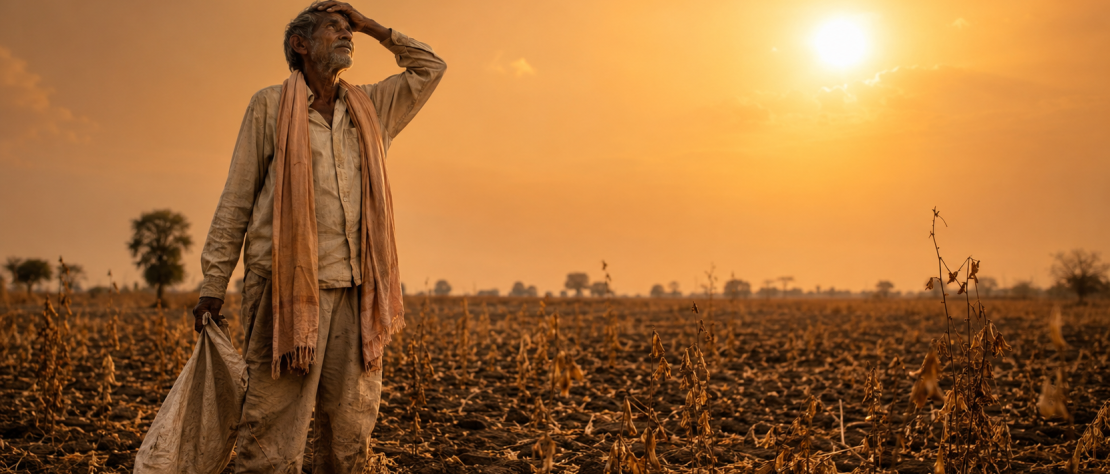
Fertilizers Costlier · Exports Blocked · Rains Failing — Kharif 2026’s Toughest Test
Author : Vijay Gaikwad Publication : krishiparva.in Date : May 21, 2026 Section : Policy Analysis | Kharif Special
“On one side, fertilizers are expensive. On the second side, exports are banned. On the third side, rains are failing. Where will the farmer go?”
✍️ Introduction
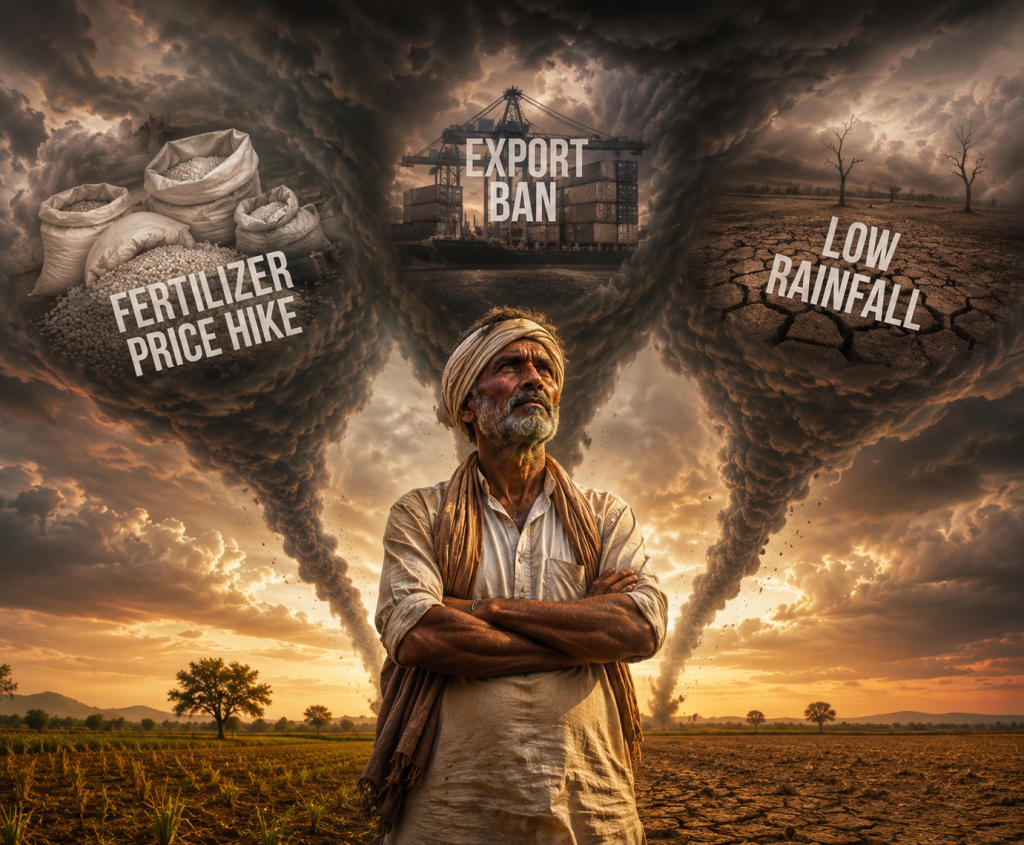
Maharashtra’s farmers are not fighting a single crisis this Kharif season — they are fighting on three fronts simultaneously.
Front One : The Iran war has pushed chemical fertilizer prices up by 40%. Front Two : A fall in soybean meal exports, import duty complications, and Trump tariffs are driving farm produce prices below MSP. Front Three : The IMD has warned that Maharashtra is likely to receive below-normal rainfall this monsoon — with 45–65% probability of deficient rains across Central Maharashtra, Marathwada and Vidarbha.
When three crises converge, only one question remains for the farmer :
“Should I sow Kharif at all? And if I do, will I earn anything?”
🧨 Front One : Fertilizers Costly, Farmer Helpless
Iran War Hits India’s Fertilizer Market Directly
In April 2026, the US-Israel-Iran conflict destabilized the Strait of Hormuz. India is the world’s second-largest fertilizer importer, sourcing 20–25% of its total fertilizer imports from Gulf nations. This single geopolitical event shook India’s entire fertilizer supply chain.
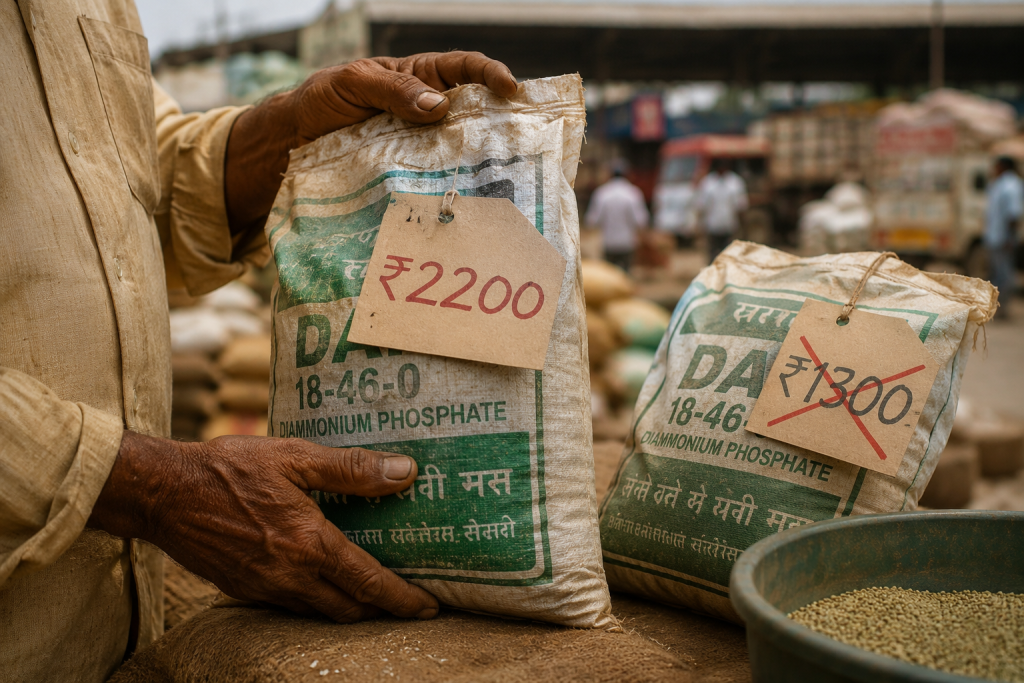
📊 Fertilizer Prices — May 2026 Reality
| Fertilizer (50 kg bag) | Pre-War Price | Current Price | Change |
|---|---|---|---|
| DAP | ₹1,300 | ₹2,100 – ₹2,200 | +70% |
| Urea (official) | ₹280 | Black market ₹1,100 – ₹1,200 | +340% |
| NPK 10:26:26 | ₹1,470 | ₹1,850 – ₹1,900 | +29% |
| NPK 20:20:0 | ₹1,400 | ₹1,500 | +7% |
| SSP (Single Super Phosphate) | ₹530–₹590 | ₹570–₹700 | +15% |
| Pesticides | — | — | +15–25% |
📌 Sources :
- KrushiKranti — Fertilizer Price Hike Rabi 2025
- YouTube — Fertilizer Rate List 2025
- Economic Times — Iran War Kharif Impact
Why Did Prices Rise? — Three Root Causes
1. Strait of Hormuz Disrupted
The Gulf accounts for 36% of global urea exports — Iran and Qatar being the largest exporters. Qatar’s Ras Laffan Industrial City and Iran’s Kharg Island oil hub have been damaged in attacks. Vessels are avoiding the strait or facing massive insurance costs and delays.
📌 IFPRI Blog — Iran War’s Impacts on Global Fertilizer Markets
2. China Banned Fertilizer Exports
China suspended fertilizer exports to all countries to protect domestic supply. This shut India’s only alternative source. Packaging material costs (HDPE, PET) surged 70–80% due to crude oil price volatility.
📌 India Today — Iran War Disrupts Fertilizer Supply India
3. India Booked DAP at 40% Above Pre-War Prices
Indian Potash Ltd. contracted 1.35 million tonnes of DAP at $930 per tonne — roughly 39% above pre-war rates. India also procured urea at nearly double the pre-war levels.
📌 The Print / Bloomberg — India Books DAP at 40% Above Pre-War Price 📌 Indian Chemical News — Dr. MP Sukumaran Nair Analysis
What Does This Mean for the Farmer?
Before the Iran war, per-acre Kharif input cost was ₹3,500 – ₹4,000. Today it has jumped to ₹5,500 – ₹6,000 per acre. Costs have risen sharply — but farm gate prices have not.
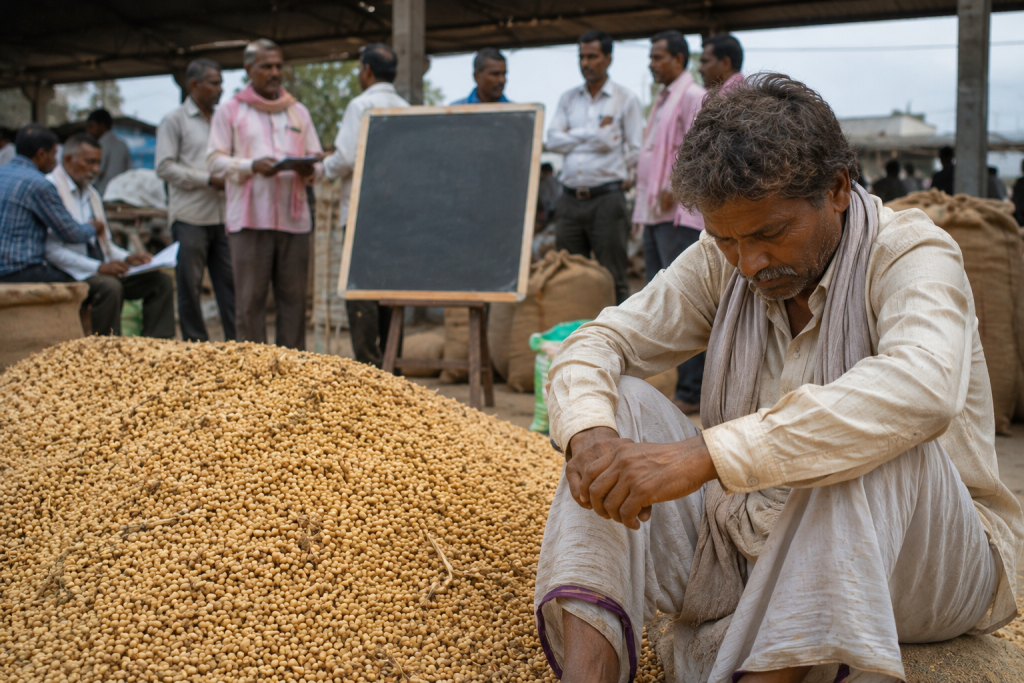
🚫 Front Two : Exports Blocked, MSP a Mockery
Soybean’s Double Crisis
Maharashtra contributes 30% of India’s total soybean production, making it the second-largest producing state. Yet after Kharif 2025–26 harvest, market prices were ₹500 – ₹1,000 below MSP.
MSP : ₹4,892 per quintal — Market Price : ₹2,500 – ₹3,500 per quintal
Key Reasons :
- Import Duty Hike Failed : September 2024’s ~20% import duty hike on edible oils was nullified by Nepal routing edible oil imports through SAFTA at zero duty — approximately 1 million tonnes expected
- Soybean Meal Export Crash : February 2025 oilmeal exports fell 36% year-on-year; soybean meal exports in the first five months fell 23%
- Corn Competition : USDA projects India’s soybean area to decline 3% in MY 2026/27 as farmers in Maharashtra and MP shift to corn driven by ethanol procurement
- Negative Crushing Margins : Weak global soybean meal prices have pushed crushing economics into the red, reducing processor demand for domestic soybeans
📌 Economic Times — Import Duty Hike Fails Soybean Farmers 📌 Economic Times — Maharashtra Soybean Export Demand 📌 USDA/FAS — Oilseeds and Products Annual India 2026 📌 PIB — Kharif 2025–26 Soybean Procurement Maharashtra
Trump Tariffs : $5 Billion Indian Agri-Exports Under Pressure
In July–August 2025, the US imposed 25–50% tariffs on Indian goods. Shrimp, Basmati rice, spices were hardest hit. A February 2026 India-US trade deal brought tariffs down to 18%, but India retained some agricultural protections.
India’s $5 billion annual agri-exports to the US remain under sustained long-term pressure.
📌 ET Now — Trump 25% Tariff India Farmers 📌 Counterview — Trump Tariff Impact on Indian Farmers 📌 US Trade Chief — India Agriculture Protections in Trump Deal 📌 White House — Trump Agricultural Tariff Modification
Onion : The Recurring Policy Mistake
Maharashtra’s onion farmers repeatedly suffer from sudden export bans, Minimum Export Price (MEP) changes, and abrupt policy reversals. This chronic policy unpredictability makes future planning impossible for farmers.
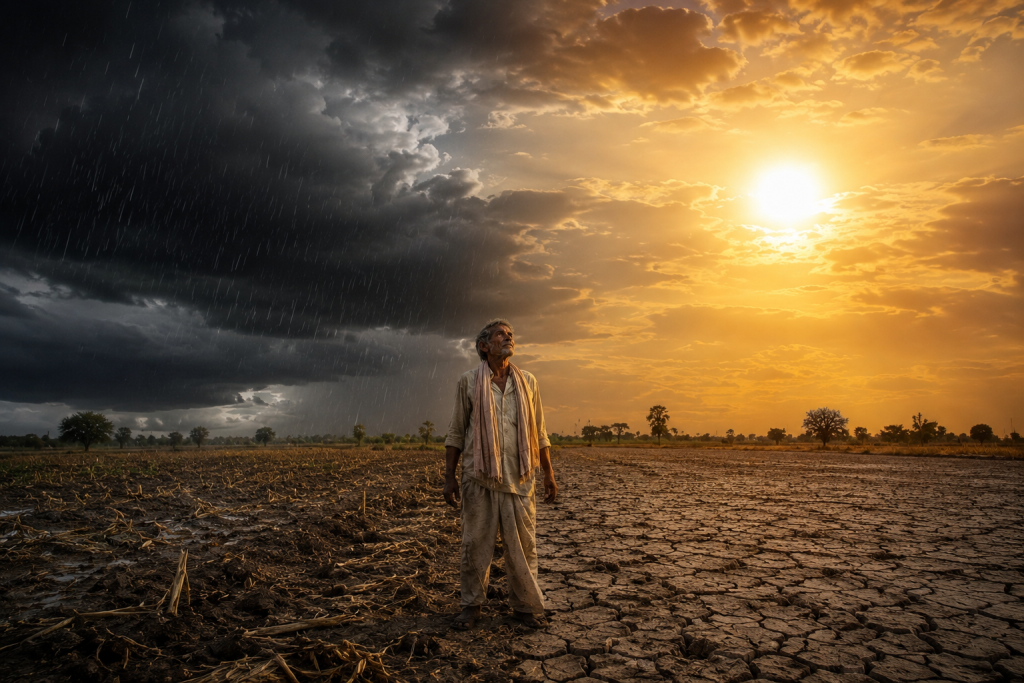
🌧️ Front Three : Rains Failing, Only Three Weeks Left
IMD Long Range Forecast — April 14, 2026
On April 14, 2026, IMD issued its official monsoon forecast for Maharashtra. The findings are alarming :
- National forecast : Only 92% of LPA — categorized as ‘below normal’
- Maharashtra forecast : 90–95% of LPA
- Central Maharashtra, Marathwada, Vidarbha : Yellow-shaded — 45–65% probability of below-normal rainfall
- Parts of Marathwada : Probability edging towards 65% and beyond
“If we look at Maharashtra as a whole, the monsoon rainfall is likely to be below normal.” — IMD Scientist SD Sanap, Times of India, April 14, 2026
📌 Times of India — Below-Normal Monsoon Likely Over Maharashtra; El Niño Signal Builds 📌 Navbharat Live — Maharashtra Monsoon Forecast 2026 IMD 📌 Skymet Weather — Maharashtra Rainfall Analysis March 2026 📌 YouTube — Monsoon Update 2026 Maharashtra Drought Risk
El Niño — What History Tells Us
El Niño years have historically delivered below-normal monsoon rainfall over India :
| Year | % of LPA | Situation |
|---|---|---|
| 1972 | 77.7% | Severe Drought |
| 2002 | 79.1% | Severe Drought |
| 2009 | 81.7% | Below Normal |
| 1987 | 85.7% | Below Normal |
| 2015 | 87.3% | Below Normal |
| 1982 | 88.6% | Below Normal |
IMD has flagged El Niño developing from late July 2026 onwards. Favourable Indian Ocean conditions may partially offset the impact — but the risk cannot be dismissed.
Two models — Japan’s JAMSTEC and India’s IMD — both say the same thing : below-normal rains. This is not a possibility. Treat it as a given.
📌 IMD Official Press Release — Monsoon 2025 Verification 📌 PIB — IMD Above Normal Forecast 2025 Background
The Three-Week Window — It Will Not Stay Open Forever
The monsoon reaches Kerala in the first week of June; Maharashtra gets it in the second–third week. We are now in late May — which means farmers have just three weeks.
The rain is in God’s hands — but the preparation is in ours. Three weeks remain. When this window closes, the opportunity is gone.
📖 The Government’s ‘290-Page Kharif Preparedness Book’ : Preparedness or Performance?
The Maharashtra Agriculture Department published a detailed Kharif 2026 preparedness document — covering seed distribution, tillage, water planning, and crop insurance in exhaustive detail.
But this book contains not a single page on :
- 🔴 Impact of the Iran war on fertilizer supply chains
- 🔴 Pressure on Indian agri-exports due to Trump tariffs
- 🔴 Any plan to increase DAP subsidy as prices surged 40%
- 🔴 A special action plan for El Niño and below-normal rainfall
- 🔴 Ensuring availability of organic fertilizer alternatives at taluka level
This is a ‘preparedness’ document — not a ‘crisis analysis’ document.
The government has prepared for the season it expected, not the season that has arrived. For Maharashtra’s farmers — this is dangerous.
🌿 Organic Fertilizer : Government Advises, But Where Is the Supply?
The government says : “Use fewer chemicals — shift to organic fertilizers.”
Sound advice on paper. Ground reality is different.
Vermicompost (Earthworm Compost) — Is It Available at the Taluka Level?
- Production is concentrated in Solapur, Sangli, Nashik, and Pune districts
- Available price : ₹10,000 – ₹11,000 per tonne (delivered within 150 km)
- Requirement per acre : Minimum 1 – 1.5 tonnes
- Cost comparison : Chemical fertilizer per acre ₹2,000–₹2,500 vs. Vermicompost per acre ₹10,000–₹15,000
- In Vidarbha, Marathwada, and North Maharashtra : Vermicompost not easily available; no government subsidy; massive gap between demand and supply
The government says use less chemical fertilizer — but where is the alternative? Is vermicompost available at the taluka level?
📌 Agrowon — Vermicompost Production Yashogatha 📌 Shubham Vermicompost Solapur
📊 The Economics of the Triple Crisis — Per Acre Numbers
| Input Cost Head | Kharif 2025 | Kharif 2026 (Est.) | Change |
|---|---|---|---|
| Seeds | ₹1,200 | ₹1,400 | +₹200 |
| DAP + NPK | ₹1,500 | ₹2,400 | +₹900 |
| Urea | ₹270 | ₹280–₹300 | +₹30 |
| Pesticides | ₹800 | ₹1,000–₹1,200 | +₹400 |
| Labour + Tillage | ₹3,000 | ₹3,200 | +₹200 |
| Total Input Cost | ₹6,770 | ₹8,200 – ₹8,500 | +₹1,730 |
| MSP (₹4,892/qtl × 6–7 qtl/acre) | ₹29,352 | ₹29,352 | = |
| Market Price (Below MSP) | ₹24,000–₹27,000 | ₹24,000–₹27,000 | Still low |
| Net Profit | Low | Even Lower 📉 | — |
Conclusion : Input costs are rising. Market prices remain stagnant. Farm gate prices are below MSP. What is left in the farmer’s hands at the end of the season?
✅ Practical Steps for Farmers — Act Now, In Three Weeks
The three-week window is open. When it closes, the opportunity is gone.
- Reconsider your crop choice : With El Niño and below-normal rain as a given, shift to low-water crops — tur, moong, kulthi, bajra
- Use SSP instead of DAP : Single Super Phosphate costs only ₹570–₹700 per 50 kg vs. DAP at ₹2,100+; it also supplies sulphur to soil
- Use your soil health card : Apply fertilizer strictly as per test results — excess fertilizer is wasted money
- Buy crop insurance now : Sowing without crop insurance when El Niño risk is elevated is gambling
- Prepare water conservation structures : Sari-varamba (ridge and furrow), contour tillage — prepare today, not after sowing
- Book vermicompost now : If a producer is nearby, order immediately — it will not be available during the season
- Buy fertilizer collectively : Farmer group bulk purchases can get wholesale discounts
🏛️ Five Urgent Policy Demands
- Increase DAP subsidy immediately : The war-driven fertilizer price surge must be absorbed by the central government, not farmers. The Fertilizer Association of India (FAI) has already demanded this
- Open MSP procurement centres before the season : The Centre has approved ₹9,860 crore for Maharashtra soybean procurement — ensure it reaches every taluka on time
- Announce an El Niño action plan : Clarify NDRF/SDRF relief criteria in advance if below-normal rainfall materializes
- Establish taluka-level vermicompost centres : Every taluka must have at least one government-subsidized vermicompost production centre
- Set up a permanent Geopolitical-Agriculture Crisis Analysis Cell : The Agriculture Department needs a dedicated cell to assess the Kharif impact of events like the Iran war — before the sowing season begins
📌 PIB — Kharif Procurement Approvals 2025–26 📌 Dhanashree — Natural Farming as Hedge Against Fertiliser Risk Kharif 2026
🎯 Conclusion : Both God and Government Must Be on the Farmer’s Side
The rain is in God’s hands — that is true. But preparation is in our hands — that is equally true.
IMD and global climate models speak in one voice : Maharashtra faces a 45–65% probability of below-normal monsoon rainfall in 2026 — with Marathwada facing even higher odds. This is not a possibility. Plan with it as a baseline asumption.
The Iran war, Trump tariffs, and export uncertainties seem distant — but their impact is visible right now in the price of a fertilizer bag in Ahmednagar, Latur, and Akola. When global and local crises converge, the damage is compounded.
The government’s 290-page preparedness document is a useful operational checklist. But what Maharashtra’s Kharif 2026 demands is crisis analysis, policy flexibility, and an action framework grounded in current reality — and that framework is yet to be built.
Where will the farmer go? — This question is easy to ask. To answer it, the government must wake up. And the farmer must make smart decisions in these three remaining weeks.
📚 All References — With URLs
| # | Source | URL |
|---|---|---|
| 1 | IFPRI — Iran War Fertilizer Markets | Link |
| 2 | The Print — DAP 40% Above Pre-War | Link |
| 3 | Economic Times — Iran War Kharif | Link |
| 4 | India Today — Iran War Fertilizer | Link |
| 5 | Indian Chemical News — Dr. MP Sukumaran Nair | Link |
| 6 | TOI Pune — Below Normal Monsoon Maharashtra | Link |
| 7 | Navbharat Live — IMD Maharashtra 2026 | Link |
| 8 | Skymet — Maharashtra Rainfall 2026 | Link |
| 9 | IMD Press Release 2025 | Link |
| 10 | PIB — IMD Monsoon Forecast | Link |
| 11 | ET — Soybean Import Duty Failure | Link |
| 12 | ET — Maharashtra Soybean Export Demand | Link |
| 13 | USDA/FAS — Oilseeds Annual India 2026 | Link |
| 14 | PIB — Soybean Procurement Maharashtra | Link |
| 15 | ET Now — Trump 25% Tariff India Farmers | Link |
| 16 | Counterview — Trump Tariff Indian Farmers | Link |
| 17 | Economic Times — US Trade India Agriculture Deal | Link |
| 18 | White House — Trump Agricultural Tariff Modification | Link |
| 19 | Agrowon — Vermicompost Production | Link |
| 20 | Shubham Vermicompost Solapur | Link |
| 21 | KrushiKranti — Fertilizer Price Rabi 2025 | Link |
| 22 | YouTube — Monsoon 2026 Maharashtra Drought Risk | Link |
© krishiparva.in Vijay Gaikwad | Senior Journalist & Policy Analyst Contact : krishiparva.in