
— Vijay Gaikwad
“When the Rains Come, the Good Mango is Gone” — An Old Myth, A New Truth
When June clouds begin to gather over the ridges of the Western Ghats, most consumers across Maharashtra accept a cultural certainty — “When the rains come, the good mango is gone.” Traders in the market say it with conviction, homemakers believe it without question, and farmers — they simply smile to themselves.
Because they know: the Junnar Hapus arrives in the market precisely when the first monsoon clouds are still lingering over the Sahyadri.
This is not a misconception born of malice. It is born of ignorance. And dismantling that ignorance — that is Junnar Hapus’s greatest battle.
Geography Speaks — And the Market Listens
Across the long history of global agricultural trade, one unwritten law endures: what grows in a land carries that land’s blood. Why are the grapes of Bordeaux distinct from every other wine region in the world? Why does Parmigiano-Reggiano from Italy command a global premium? Because the soil, the climate, the altitude, and centuries of farming tradition together create something irreplaceable — a terroir — the taste of place.
Maharashtra is no exception.
Nashik and Sangli grapes earn a special export window in European markets from January to April — because European domestic grapes simply aren’t available during those months. From distribution hubs in the Netherlands, Germany, and Romania, Indian grapes reach every corner of Europe. This is not merely commercial arithmetic — it is a gift bestowed by geography.
And that same power of place — that same terroir — lives inside the Junnar Hapus. Only its language is different, its season is different, its soil is different.
Konkan to Ghatmatha — An Emotional and Geographical Journey
By the end of May, the Hapus season in Devgad and the Konkan draws to a close. The mango trees of Ratnagiri, Sindhudurg, and Devgad release their last fruit, the markets grow quiet, and a quiet longing settles in the hearts of consumers.
But at precisely that moment — on the eastern flank of the Western Ghats, where the humid warmth of the Konkan and the cool breath of the Ghatmatha meet — the mango orchards of Junnar, Ambegaon, and the plateau highlands are slowly, steadily, ripening.
This journey from Konkan to Ghatmatha is not merely geographical — it is a journey of seasons, a journey of flavours. The Konkan Hapus receives the salt-tinged breeze of the Arabian Sea; the Junnar Hapus breathes the cool, still air of Sahyadrian valleys.
The Junnar-Ambegaon region sits at an elevation of 700 to 900 metres above sea level. On this highland plateau, cool nights, moderate daytime warmth, and the gentle touch of westward monsoon clouds create conditions where the mango ripens slowly but with extraordinary intensity. Sugar content deepens, colour blooms, fragrance concentrates. The season arrives late — but when it does, it arrives abundantly.
Three and a Half Centuries of Roots — From Malik Ambar to the Peshwas
The history of Junnar Hapus does not stretch back a hundred years — it stretches back more than three and a half centuries. And this is not merely oral tradition; it is documented in historical records, Peshwa-era chronicles, and medieval literature.
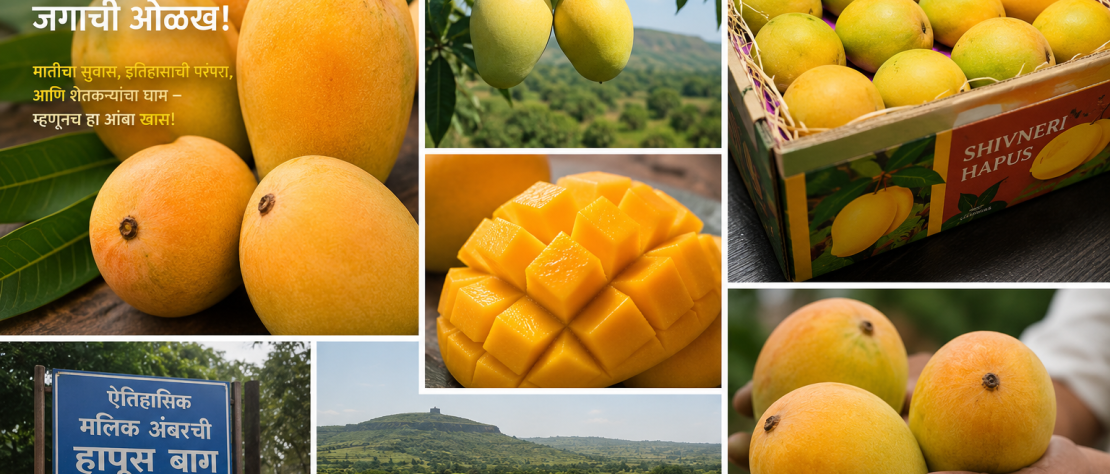
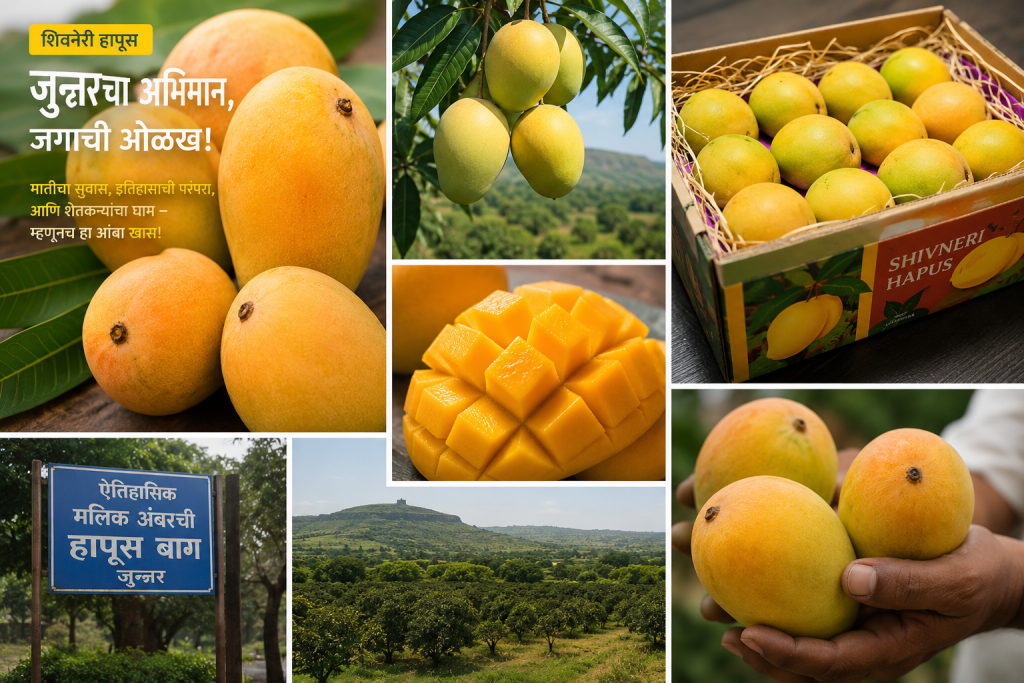
The ancient Satavahana text ‘Gathasaptashati’ contains references to the mangoes of the Junnar region — the oldest known literary evidence of the bond between this land and its fruit. Historical documents from the medieval period and from the era of Chhatrapati Shivaji Maharaj also carry references to this mango — and it is no coincidence that its roots are embedded in the very soil surrounding Shivneri Fort, the birthplace of the great king. The palace of Malik Ambar, the powerful Nizamshahi regent who once governed from Junnar, is to this day known locally as ‘Hapus Baag’ — the name itself carrying centuries of memory. Peshwa-era chronicles describe Junnar’s Hapus in vivid detail, documenting both its character and its orchards.
Botanists who studied the historic orchards measured the girth of surviving trees and confirmed that several are centuries old — living witnesses to a legacy that no document alone can fully capture.
Today, approximately one thousand acres are under Junnar Hapus cultivation. The area may not rival the Konkan in scale, but every tree in these orchards stands as a living monument to a long and glorious tradition.
A Dream Fulfilled — ‘Shivneri Hapus’ Receives the GI Tag
In December 2024, a historic moment arrived for the farmers of Junnar taluka — the Central Government officially awarded the Geographical Indication (GI) tag to ‘Shivneri Hapus’ mango. The GI Registry of India, based in Chennai, published the official government journal, and Junnar made history. Just as Ratnagiri Hapus is recognised internationally, Junnar’s mango will now be known across the world by its own distinct name — ‘Shivneri Hapus.’ Notably, the same gazette also awarded GI tags in the agricultural category to Pimpali from Amravati (a medicinal herb), Chana (chickpea) from Amravati, and Kagzi Limbu from Akola — all three proposals were also drafted and presented before the expert committee by Ganesh Hingmire himself.
This achievement did not come overnight. Behind it lies three years of relentless pursuit.
GI expert Ganesh Hingmire first presented the concept to the administration. But the challenge was enormous: with “Hapus means Ratnagiri or Devgad” deeply entrenched in public perception, proving scientifically that Junnar’s mango is a distinct variety was non-negotiable. Hingmire partnered with Tatya Meher, head of KVK Narayangaon (Krushi Vidyan Kendra), to build a comprehensive proposal combining scientific, geographical, technical, and historical evidence.
The decisive breakthrough came from the Agharkar Research Institute, which conducted DNA Profiling of Shivneri Hapus and scientifically established that it is a variety distinct from Ratnagiri Hapus in shape, weight, taste, colour, and aroma. The Gathasaptashati, Peshwa chronicles, Malik Ambar’s Hapus Baag, botanical field surveys, and the DNA report — together, these built an irrefutable case before the GI expert committee.
MP Dr. Amol Kolhe drove the matter at the Central level from 2022 onwards, corresponding directly with Union Commerce Minister Piyush Goyal. Guardian Minister Ajit Pawar, former MLA Atul Benke, and Anil Meher also extended their support to carry the effort across the finish line.
Dr. Kolhe’s words capture the moment: “Just as Kashmiri saffron, Banarasi saree, and Darjeeling tea are recognised across the world, Shivneri Hapus has now found its own independent place on the global map.”
GI Tag — Not Just a Legal Stamp, But a Historic Salute
A GI tag is not merely a government certificate. It is an honour — a formal acknowledgement of soil, climate, generations of labour, and the living traditions of farming communities.
This GI tag carries an additional distinction worth noting: Maharashtra has now emerged as the Number One state in India for agricultural GI tags. Previously, Maharashtra’s mangoes had earned GI recognition for Konkan Hapus and Marathwada’s Kesar. With Shivneri Hapus, a third golden name has been added to this proud lineage.
France celebrates its geography through Champagne wine. Italy takes pride in Parma ham and Pecorino Romano cheese. Scotland guards its Single Malt Scotch Whisky with GI protections — because the Scots understand instinctively that a Speyside whisky and a Highland whisky cannot be the same, even if the still is identical.
Devgad Hapus and Shivneri Hapus — both are Hapus, but they belong to two different worlds. One was blessed with the sea, the other with mountains. One ripens in the height of summer, the other on the threshold of monsoon. This diversity is Maharashtra’s strength — and the GI tag announces that strength to the world.
Shivneri Hapus Goes Digital — From Orchard to YouTube
Since receiving the GI tag, Shivneri Hapus has built not just a legal identity, but a digital one. The official “Shivneri Hapus शिवनेरी हापूस” YouTube channel is actively sharing Shorts from the 2026 harvest season — orchard visuals, fruit picking, and market dispatches — giving consumers a direct, unfiltered window into the farm.
Videos published in May 2026 show the current season in full swing. This is more than marketing; it is the power of a farmer telling his own story, in his own words, to the world — without middlemen, without adulteration, and without borrowed identity. The GI tag and YouTube together are building a new brand architecture for Shivneri Hapus, one that is rooted in both tradition and the digital age.
🎬 Shivneri Hapus YouTube Channel
The Sahyadri Speaks — The Mango Listens
In the first week of June, when Mumbai receives its first rains, the mango orchards of Junnar hold a different atmosphere entirely. Yellow-orange fruit sways on the branches, the orchard keeper watches the sky with careful eyes — measuring every drop of water, reading the Sahyadrian wind — and sends his Hapus to the market.
When this mango arrives at the markets of Pune and Mumbai, it carries with it a history, a geography, a soil — and a fragrance found nowhere else.
Epilogue: The Fragrance of Soil, Science, and Pride
When the world bestowed recognition on names like Bordeaux, Champagne, and Darjeeling, one simple truth stood behind each of them: Geography cannot be changed — and the flavour that geography creates cannot be replicated.
Junnar Hapus is not merely a late-season mango. It is the story of Maharashtra’s highland plateau. It is a witness to the journey from Konkan to Sahyadri. It is the fruit of three and a half centuries of farming tradition — from Malik Ambar’s Hapus Baag to the DNA laboratory of the Agharkar Research Institute. And it is the answer to that stubborn myth that says, “When the rains come, the good mango is over.”
No — when the rains come, Junnar’s Hapus begins.
Junnar Hapus is not merely a mango; it is the fragrance of Maharashtra’s geography, science, young leadership, and farmer pride.
Vijay Gaikwad is a senior agricultural journalist and policy analyst. He is the founder of krishiparva.in and TheNews21, and serves as Director of Strategy & PR at F2F Corporate Consultants.
For more information, contact: Abhimanyu Kale (IAS Retd.) 📞 +91 98694 05001