
SPECIAL REPORT | TECHNOLOGY & GEOPOLITICS
The Chip War Escalates:
As Washington targets China’s No. 2 chipmaker, the battle for semiconductor supremacy enters a dangerous new phase — and India must pay attention
Vijay Gaikwad | Krishi Parva |
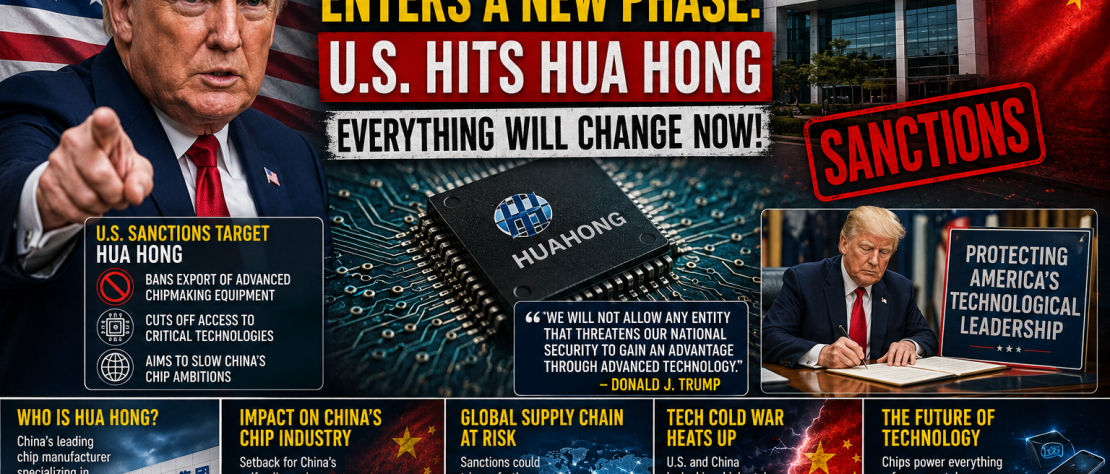
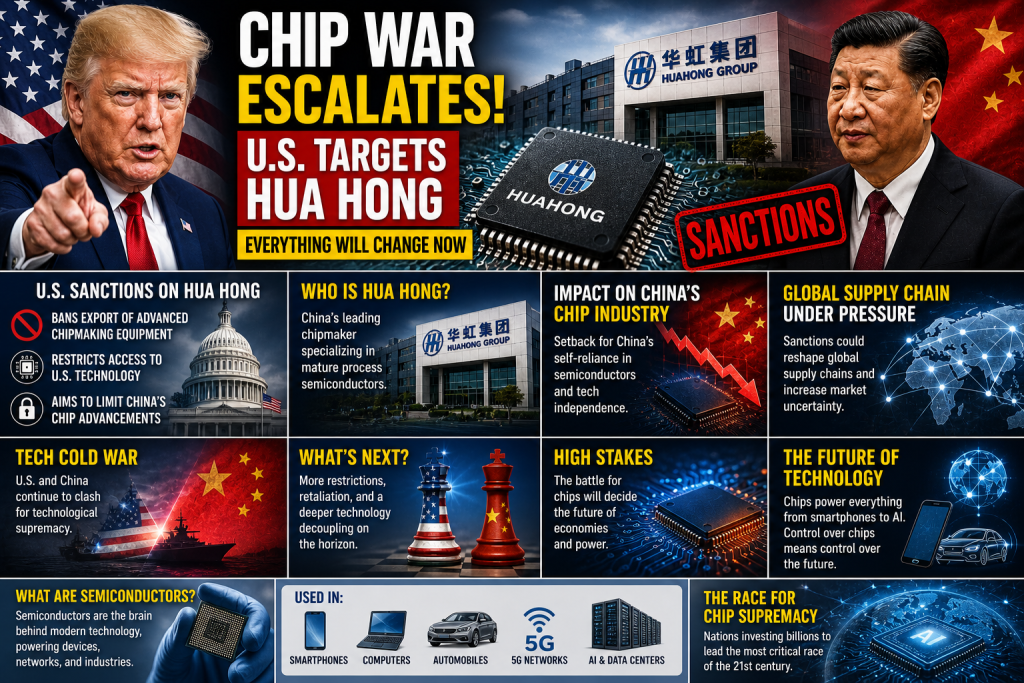
In the annals of modern geopolitical conflict, wars are no longer fought only with missiles and soldiers. They are fought with export control letters — quietly, precisely, and with devastating long-term effect. The latest salvo in the US-China technology war came last week when the US Department of Commerce ordered leading chip equipment makers to halt certain shipments to Hua Hong Semiconductor — China’s second-largest chipmaker. It was a targeted strike. And it signals that the most consequential technology war of the 21st century has entered a new, irreversible phase.
What Happened — and Why It Matters
The US Department of Commerce sent letters to at least a handful of companies — including top chip equipment firms Lam Research, Applied Materials, and KLA — informing them of new restrictions on tools and materials destined for two Hua Hong facilities that US officials believe may be used to manufacture China’s most sophisticated chips.
On the surface, this looks like another round in America’s ongoing effort to deny China access to advanced semiconductor technology. But look closer, and the stakes become extraordinarily high.
In March 2026, Reuters reported that Hua Hong Group had developed advanced chip manufacturing technologies capable of producing AI chips — a significant milestone in Beijing’s efforts to achieve tech self-sufficiency. Its contract manufacturing subsidiary, Huali Microelectronics, was preparing a 7-nanometer chipmaking process at its Shanghai plant — a capability previously held exclusively by SMIC, China’s largest chipmaker.
Seven nanometers. That is the threshold that separates commodity chips from the kind of advanced semiconductors that power artificial intelligence, modern military systems, and next-generation telecommunications. When China crossed that line — or came close to crossing it — Washington acted.
The Huawei Connection — A Strategic Alarm Bell
Huawei Technologies — already on the US trade blacklist — has been collaborating with Hua Hong and planning to move part of its AI chip production from SMIC to Hua Hong. Huali’s research and development of 7-nanometer chips at its Hua Hong Fab 6 site began last year with support from Huawei-backed SiCarrier.
This is the detail that transforms a trade restriction into a national security action. Huawei is not merely a telecommunications company. It is at the heart of China’s AI ambitions, its military-civil fusion strategy, and its global infrastructure projects. If Hua Hong — operating below the radar compared to SMIC — had successfully become Huawei’s alternate chip supplier, it would have represented a significant breach in America’s semiconductor containment strategy.
Washington saw the gap. And closed it — at least partially.
The Escalating Architecture of the Chip War
This action does not exist in isolation. The strategic logic has been building systematically: chip export rules were updated in October 2023 to close loopholes, expanded in December 2024 to cover high-bandwidth memory, and supplemented in January 2026 when the Trump administration imposed a 25% Section 232 tariff on advanced semiconductor imports.
The goal is clear — deny China the tools to produce cutting-edge AI chips while the United States and its allies maintain a generational technological lead. But China has not been passive.
China has retaliated with its own export controls — restricting gallium, germanium, antimony, and rare earths like terbium and dysprosium. Beijing has also required domestic chipmakers to source 50% of their equipment from Chinese suppliers, threatening an estimated $18 billion in annual US equipment sales.
This is no longer a trade dispute. It is a full-spectrum technology war — fought across supply chains, export regulations, raw material controls, and corporate investment decisions simultaneously.
Who Bleeds? The Cost of Containment
Geopolitical strategy has economic casualties. US chip equipment suppliers could potentially face billions in losses, particularly if they supply plants that are being built or are transitioning to making advanced chips.
Lam Research, Applied Materials, and KLA are not small players. They are the backbone of global semiconductor manufacturing — companies whose tools are essential to building chips at any node. Restricting their access to China does not merely hurt their revenues; it restructures the entire global semiconductor supply chain.
And China, for its part, is not without options. While the restrictions might slow China’s chip progress, Hua Hong could potentially find replacements from other foreign or domestic suppliers.
Beijing’s domestic semiconductor equipment industry — companies like NAURA Technology and AMEC — has been growing rapidly, fuelled by government subsidies and a national urgency to replace American tools. The restrictions may slow China’s progress. They are unlikely to stop it.
The Diplomatic Fault Line
These actions may heighten tensions with China, especially with a meeting between President Donald Trump and Chinese President Xi Jinping planned for May.
The timing is diplomatically sensitive. Imposing restrictions on Hua Hong just weeks before a potential Trump-Xi summit suggests that America’s chip containment strategy is now considered non-negotiable — a floor below which no diplomatic accommodation will reach. China’s Ministry of Foreign Affairs spokesperson Lin Jian stated that China hopes the US would take concrete actions to maintain the stability and smooth functioning of global industrial and supply chains.
That statement — carefully worded, diplomatically calibrated — barely conceals Beijing’s frustration. China knows that every restriction imposed now makes its path to semiconductor self-sufficiency longer, costlier, and more uncertain.
The Bigger Picture — AI, Power, and the Future
At its core, this is a war about who controls the infrastructure of artificial intelligence. Advanced chips — particularly those at 7nm and below — are not consumer products. They are the engines of AI model training, military targeting systems, autonomous weapons, financial market surveillance, and the next generation of communication networks.
Whoever controls the fabrication of these chips controls the future of AI. And whoever controls AI controls an extraordinary concentration of economic, military, and political power.
America understands this. China understands this. And the rest of the world — including India — is watching.
India’s Strategic Moment
India sits at a unique intersection in this conflict. It is neither fully aligned with Washington’s containment strategy nor with Beijing’s resistance to it. But the chip war creates both an opportunity and an obligation.
The opportunity: as American companies are forced to reduce China exposure, as global semiconductor supply chains are restructured, India — with its India Semiconductor Mission, growing engineering talent, and strategic partnerships with the US, Japan, and the EU — has a narrow but genuine window to become a meaningful node in the global chip supply chain.
The obligation: India cannot remain a passive consumer of the technologies that will define the next fifty years. As Nanasaheb Patil warned at YASHADA, Pune — India’s dependence on Chinese inputs across pharmaceuticals, fertilisers, and electronics is not merely an economic vulnerability. It is a strategic liability. The chip war between the US and China is a vivid demonstration of what happens when a nation allows critical technology dependencies to accumulate unchecked.
India’s semiconductor ambitions — currently focused on assembly, testing, and packaging — must evolve into genuine fabrication capability. That will require policy consistency, patient capital, and the kind of long-term strategic thinking that has so far been more promise than practice.
Conclusion — The Letter That Changed the Equation
A letter from the US Department of Commerce. A few companies told to stop shipping tools. On the surface, bureaucratic and routine.
In reality — a turning point.
The action against Hua Hong confirms that the United States views semiconductor supremacy as a matter of national survival, not commercial preference. It confirms that China’s path to AI chip independence will be contested at every step. And it confirms that the world’s most important technology battleground is not a battlefield — it is a fabrication plant, a supply chain, and an export control list.
The Chip War is not coming. It is here. And for every nation that has not yet decided where it stands — including India — the window to choose is closing.
Vijay Gaikwad
Senior Agricultural Journalist & Policy Analyst, Mumbai
Krishi Parva | krishiparva.in |